
Wim T. Schippers’ Peanut Butter Floor occupies a
distinctive place in post-war Dutch art, combining
conceptual precision, material experimentation and absurdist humour. The concept dates from 1962, when Schippers became associated with the Fluxus movement.
In 2010, Museum Boijmans Van Beuningen in Rotterdam, the Netherlands, acquired the work after earlier
exhibitions at the Mickery theatre in Loenersloot in 1969 — founded by Ritsaert Ten Cate, my beloved mentor — and at the Centraal Museum in Utrecht in 1997. Rather than preserving a single physical floor, the museum acquired the right and instructions to reconstruct it according to Schippers’ specifications. In this sense, the work belongs to a conceptual tradition in which authorship lies not only in the artist’s hand, but also in the idea, the instructions and the possibility of repetition.
Following Schippers’ death in June 2026, Peanut Butter Floor was installed again in the museum’s Depot. This version used 390 kilograms of smooth peanut butter spread across a 25-square-metre hexagonal surface. Schippers had specified 15.6 kilograms per square metre and required the material to be spread as evenly and
monotonously as possible.
The tension between strict precision and absurd material is central to the work. A familiar household product is removed from its everyday context and transformed into art, without the need for a hidden narrative or educational message.
More than sixty years after its conception, Peanut Butter Floor still raises a fundamental question: when does an ordinary material become an artwork, and does art need to justify its existence? — Cees Krijnen
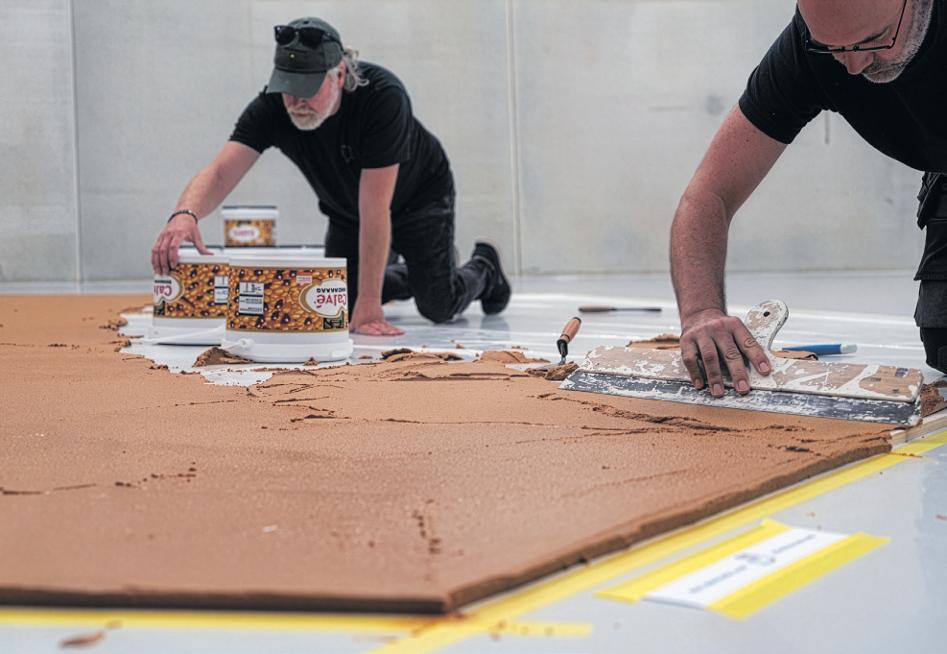
photo: Raaf Blanker Courtesy Boijmans Museum
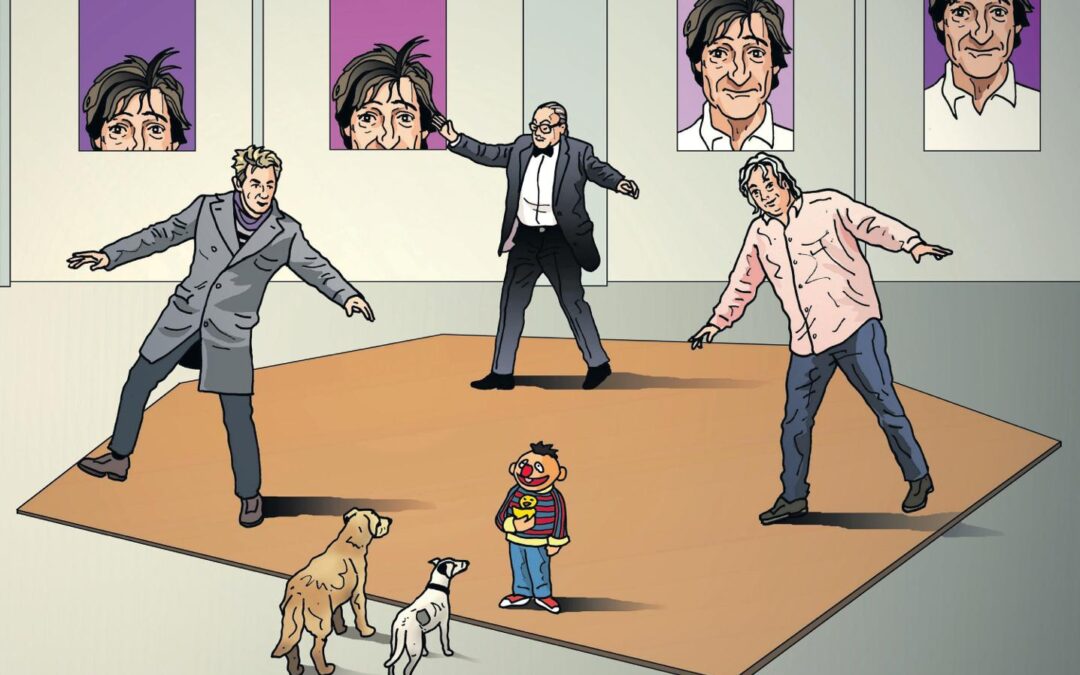
image at top: Wim T. Schippers – Illustration by Eric J. Coolen, 2026
On the wall portraits of Wim T. Schippers. On the floor, from left to right;
Cees Krijnen, Sjef van Oekel and Titus Muizelaar. In the centre: Ernie -Sesame Street- and two dogs from Wim T. Schippers’ theatre production Going to the Dogs