
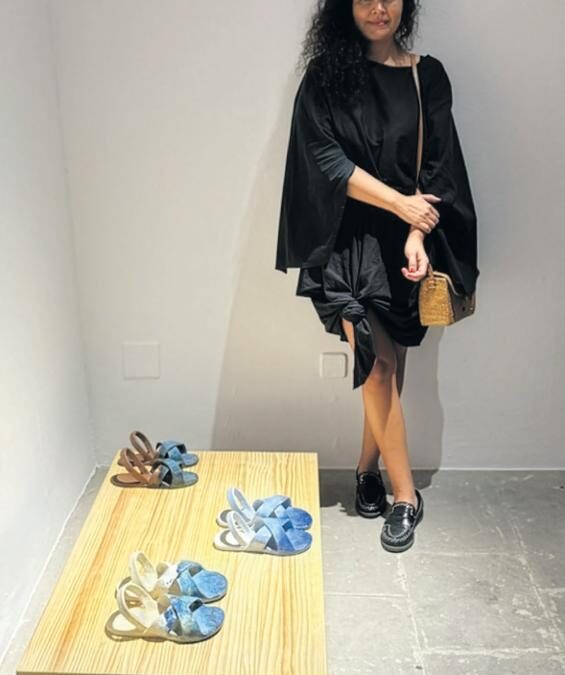
Peruvian of an impressively eclectic ethnic mix including Castellano, African, Italian and indigenous Peruvian descent, Cecilia Jurado Chueca is very passionate when recalling her family history. This includes an orphaned grandfather who as a 10 year old runaway shipped himself on a warship to Chile, and stories of forced displacement in a country with a stark recent history that reverberates in the present. Personally she spent her early years in Mexico, (Mexico City and Oaxaca), before her parents returned to Peru after completing their studies, but left for New York age 23. What was meant to be a trip, became a new life. As mother of one, New York is homebase, at least for now.
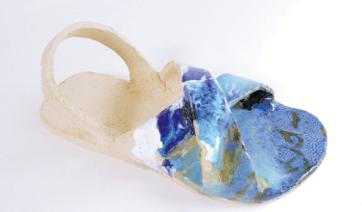
Chueca’s ancestral story however, the heritage of just so many cultures and the transgenerational navigation through it all, is an integral part of her and her work. The durable yet fragile quality of ceramic, made of burnt earth shaped with water, is one of C J Chueca’s favourite materials. Airplane windows with varying views, sunsets or sea describe a particular moment in time, and yet the moment in between, of being neither here nor there but in transit and quite literally suspended. Her ceramic shoes pay homage to the travels, the traveller, and the path travelled. From Ushuta to Ojata / The Travelling Sandal recalls the indigenous mountain dwellers from the past, crossing Andean passes and for us today unimaginable distances in nothing but leather sandals. Peru is a fasci-nating and very large country encompassing a number of climates, the Sierra mountains, jungle, desert and the sea – elements of which regularly recur in Chuecas work, water in particular.
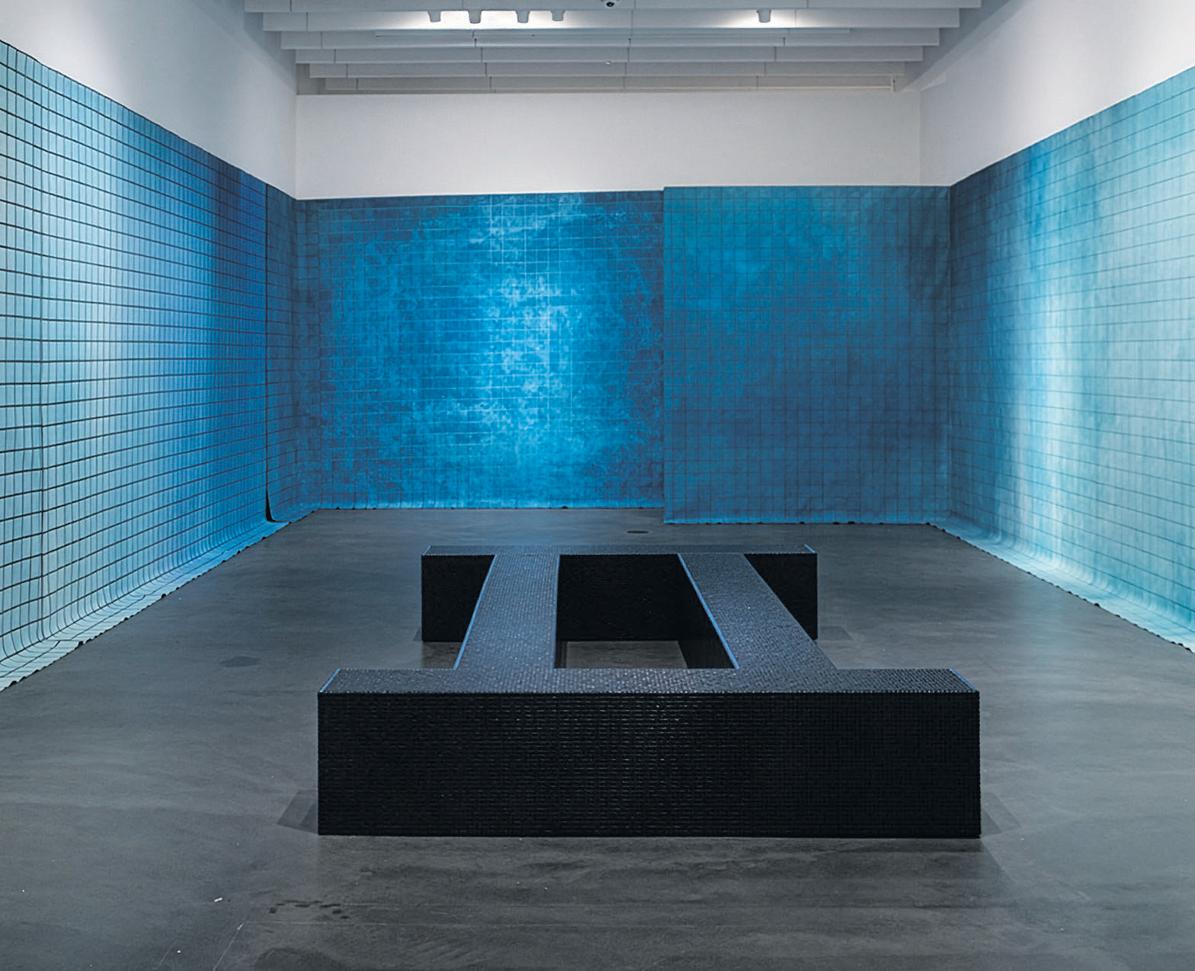
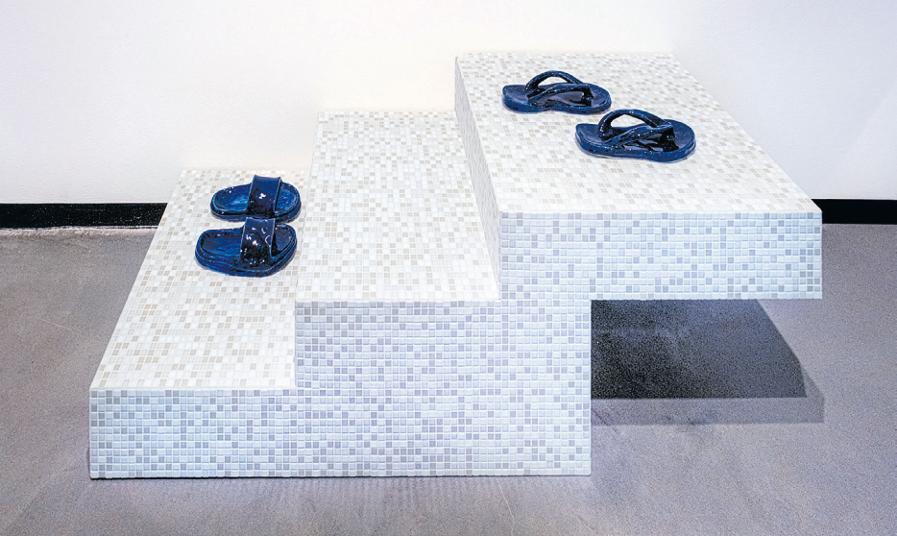
“I usually feel like water that travels through streams and rivers hurtling towards the sea. Lately however I feel quiter, a new sense of stillness,” states C J Chueca. This is a remarkable achievement which cannot stem from outer circumstance: international art travel, New York city life or the current political situation that more and more resembles the very political climate that people fled in the first place when coming to the US. Mermaids in the Basement, 2023 reflects that shift, arriving at the ocean from being carried along in rushing waters. Equally the ‘El Porvenir’ resembles a tumbling waterfall just as much as steps into the sky, a new level of existence. The Water Understands (my son and I), hand-made ceramic flipflops of Chueca and her son on swimming pool steps appear to be a giveaway — that motherhood might have something to do with the new state of being. A next generation of family, a love that is unconditional, a mother’s strength and a renewed hope – a ‘porvenir’ with purpose.— Uscha Pohl
FROM USHUTA TO OJATA. THE TRAVELLING SANDAL
Walking in the Andes has long been a form of knowledge and survival. Ushutas – ancient pre-Inca sandals – were made to assist daily journeys across the mountain range. By the 1920S, in Puno, Peru, the sandals evolved into ojotas with the incorporation of recycled rubber from tires in an act of adaptation in which a traditional object absorbs a modern material to allow for even longer journeys.
Walking in the Andes has long been a form of knowledge and survival. Ushutas – ancient pre-Inca sandals – were made to assist daily journeys across the mountain range. By the 1920S, in Puno, Peru, the sandals evolved into ojotas with the incorporation of recycled rubber from tires in an act of adaptation in which a traditional object absorbs a modern material to allow for even longer journeys.
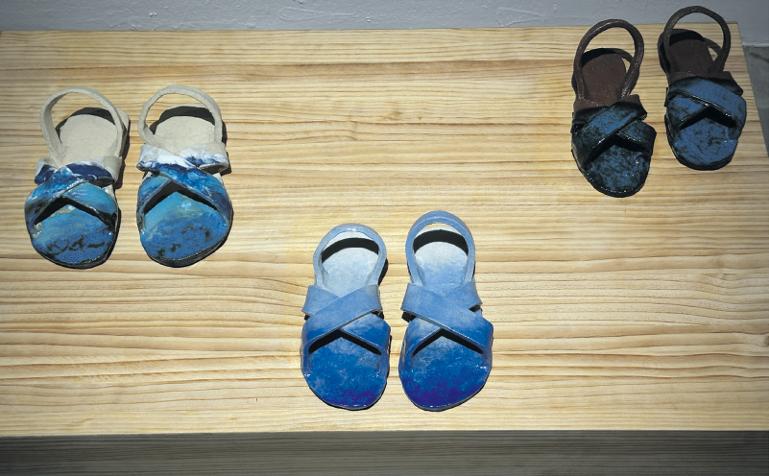
Cecilia Jurado Chueca‘s work is a ceramic reproduction of the sandals, and a gesture of preservation and resistance. Clay – matter shaped by water, time, and fire – becomes material remembrance. The act of reproducing the footwear does not anchor it in the past but calls up the symbolic weight of a journey which continues even in the absence of the body that made it.
Water, which is in intrinsic part of the ceramic process, extends into the sonic realm in All Day I Hear the Noise of Waters. Female voices from different geographies emerge and dissolve in the frequencies of water, creating an acoustic geography that connects rivers, seas, and displaced bodies. Between the sculptural piece and the sound, a dialogue unfolds where vibration replaces the lost terrain, and water runs between memory, body and landscape.
This footwear speaks to the need to preserve a tradition even when the land has been left behind. The works trace a displacement from the highlands to the sea, mountain to saltwater, as the carriers of moving bodies and memories in transforma-tion, learning to inhabit new waters without ceasing to walk. — Blanca de la Torre
Blanca de la Torre is the curator of the group exhibition A Media Lumbre, first shown at Museum IVAM in Valencia, followed
by Casal Solleric and Es Baluard in Palma de Mallorca and at CDAN in Huesca, Spain. cdan.es
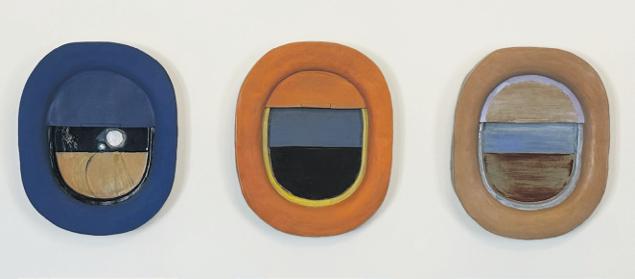
Top, right: Cecilia Jurado Chueca with her work at Casal Solleric, Palma, De Ushuta a Ojota. La sandalia viajera (From Ushuta to Ojata / The Travelling Sandal), 2026, hand-moulded ceramics, glazes, and audio. above: Seats 8A & 8B (New York – Lima); Seat 4B; Seat 30H (memorias del desierto de Lima), all from the series We Are Night and Day, 2019-2025, ceramics, presented by Patrice Farameh / Nomadic Arts and Blue Gaydon in collaboration with Kates-Ferri Projects, NY at the Palma residence of Heinz Ackermans for Palma‘s Nit de L‘Art 2026, photos Uscha Pohl
EL PORVENIR
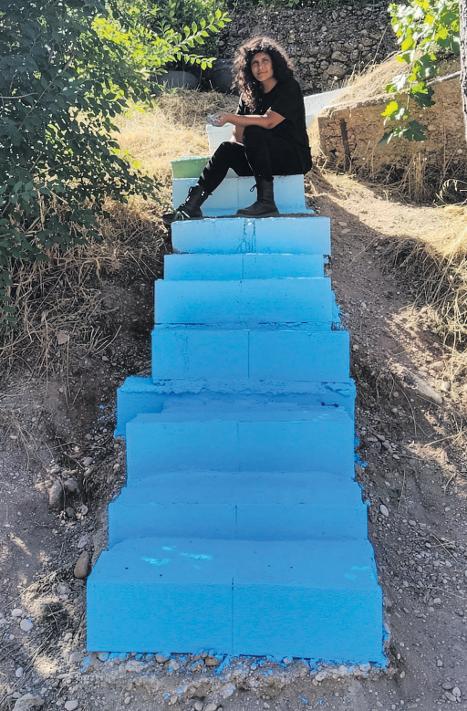
In 2025 I was asked by Gabriela Wiener and Jaime Rodriguez to make a work in Sudakasa, a cultural center outside Madrid where creative thinkers mostly from Latinoamérica – called ‘Sudaka – discuss their projects, political plights and dreams through residencies, festivals and panel discussions. People also go to pass a beautiful time as we did in great company with Karina Rodriguez the coordinator. I am very impressed by their commitment to build a community and give space to many voices, some of them otherwise unheard.
“El Porvenir” in a literal sense means ‘that what is to come’ – making the the idea of ‘future’ sound even less predictable than it already is– if that was even possible. El Porvenir is also the name of a few neighbourhoods, streets and spaces in Perú in working class areas where such a name suggests a tangible need for hope for the inhabitants of the region. In Magdalena Del Mar, my hometown in Peru, I have a ‘pasaje’ – an alleyway – called El Porvenir right next to my street called
‘Progreso’ – Progress. I always thought that those names were there for us to live them with meaning, and immeasurable hope. — C J Chueca
MERMAIDS IN THE BASEMENT
For Mermaids in The Basement, C.J. Chueca transforms the gallery into a metaphorical space where the different works on display take their titles from poems related to water, intertwining into an immersive installation. The title of the exhibition, taken from a poem by Emily Dickinson, suggests a displacement from a natural place, like the sea or any of our own ecosystems, to an urban environment.
Mermaids in The Basement — Solo exhibition at Sugar Hill Museum in Harlem, New York
curated by Blanca de la Torre
Top: Mermaids in the Basement, 2023, hand-made ceramics, mosaic, audio, acrylic and pigments on canvas. Below: The Water Understands (my son and I), 2023 hand-made ceramics and mosaics. right: El Porvenir, 2025; stairs: paint and cement at Sudakasa
@c.j.chueca