
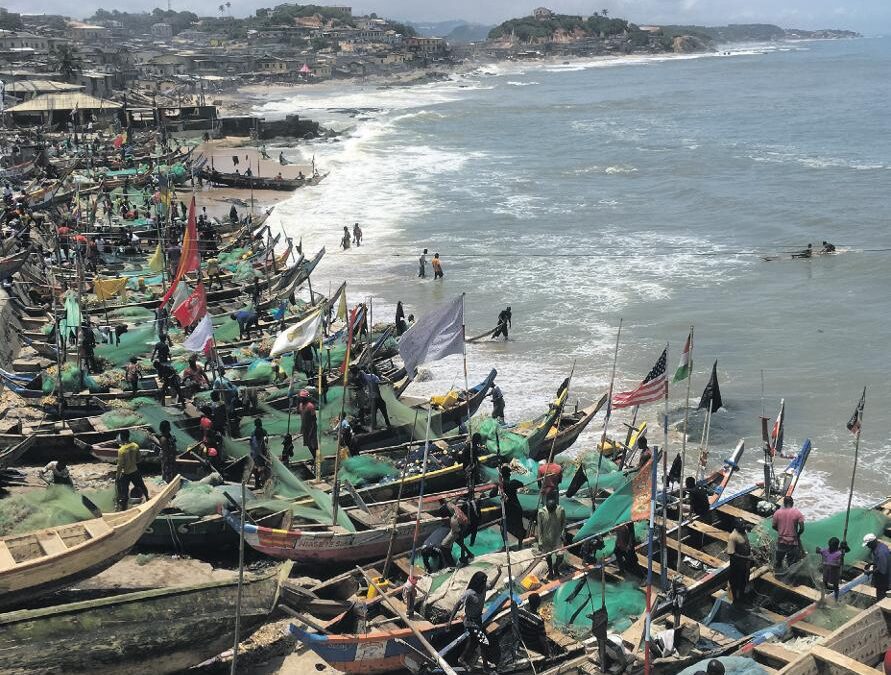
After an invitation from Gallery 1957, Accra, Ghana, in August 2018, we visited Ghana 7 times to research, survey and photograph the architecture of the European slave forts built on the coast following the construction of Elmina Castle by the Portuguese in 1482. Originally established as trading posts for gold, ivory and other valuable commodities, these structures were soon transformed into massive fortified dungeons holding thousands of captives in appalling conditions to be sold and shipped in chains to the Americas for lives of bondage, brutality and servitude.
Today the forts bear witness to the fearful history of unequal power relations between Europe, West Africa and the Americas over almost four centuries, a history subject to a kind of wilful amnesia, intentionally forgotten or ignored in the West until recently.
Ever interested in strategic architecture and the role it plays in shaping all our lives we conducted further research at the Furley Collection of the Balme Library, University of Legon, Accra, The City Archives, Amsterdam, The Dutch National Archives in the Hague and The UK National Archives in London, before collaborating with Ghanaian master artisans, Baba Issaka and Eric Kwasi Danguah, to make a series of artworks for the exhibition that included stretched cotton appliqué tapestries, wood carvings and a video installation. —Langlands & Bell
The Past is Never Dead … is the first part of a line taken from William Faulkner’s novel Requiem for a Nun published in 1951 where he wrote:
’The Past is Never Dead … it’s not even past’
i.e. the past can’t be forgotten, denied or ignored, it always influences the present.
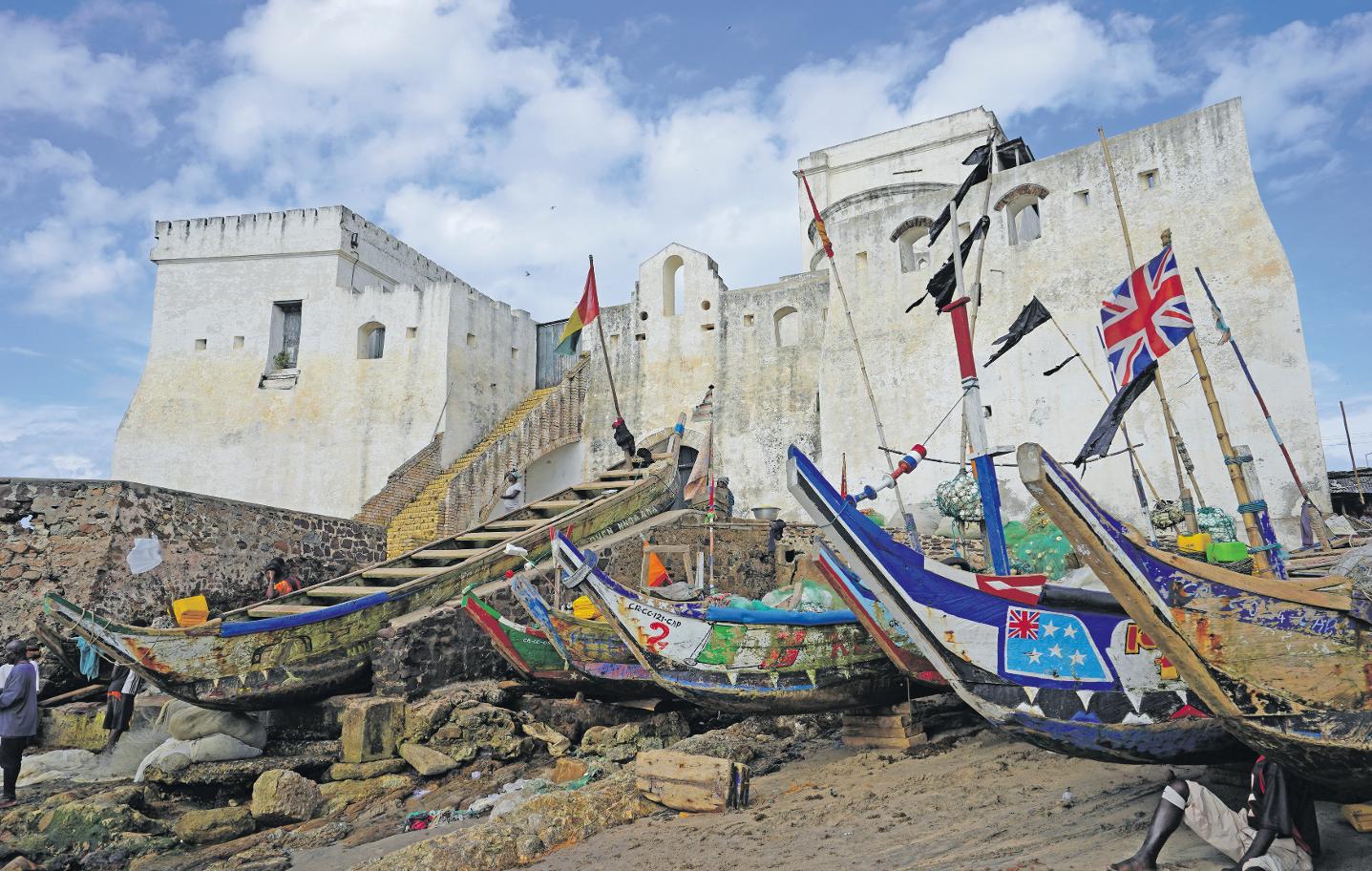
Cape Coast Castle, Ghana, photos Langlands & Bell
IN CONVERSATION: GUS CASELEY-HAYFORD AND JONATHAN WATKINS WITH ARTISTS LANGLANDS & BELL
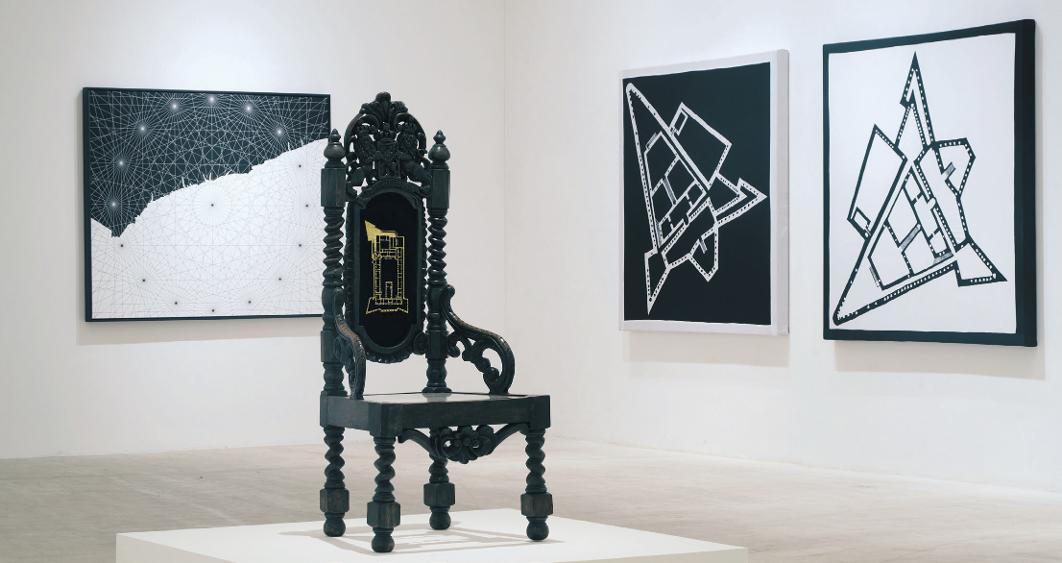
The Governor’s Chair 2021 with Wind Routes of the Gold Coast 2021
Gus Casely-Hayford When I think about the range of issues raised by your work – of enslavement, of colonia-lism, of racism and everything that has happened subse-quently in the post-colonial period to this constellation of peoples of African descent – they are subjects that fill me with such a level of emotional intensity that I find it very difficult to imagine how I might navigate it.
And your work is about navigation and orientation, but it is very minimalist. How do you feel about giving us so little aesthetically to consider so much.
Langlands & Bell We asked ourselves the same ques-tion, and did so too a few years ago when we were researching a project in Afghanistan. How can you make work about a situation which is so extremely painful, so complex, with ramifications that seem endless? But then you’ve got to start somewhere, and we start with what we know and that is architecture. For us architecture is a way of looking at human relations, whether they are inter-personal, political, economic, historical, cultural or a combination of any of these things.
Ultimately, architecture is a tangible record. It is our consciousness made material.
GC-H But this architecture is from the West, architecture that came to maturation in the 18th century, when colo-nialism was at the height of its intensity …
L&B … and this is very interesting to us. We didn’t learn about the history of slavery when we were at school and finally we’re learning it now, having been invited to work in Ghana. Now we are looking at the subject in depth, finding out so much that we didn’t know. For example, the huge loan the British Government took out in 1833 to pay off the slave owners at abolition of slave owner-ship. The slaves didn’t receive any compensation and the debt was only paid off by the UK tax-payer in 2015! We’re deeply shocked that it’s not more widely known. Every school in Britain should teach this history and it’s shocking they don’t. It is, after all, a shared history. GC-H That omission is not an accident. We are almost consciously complicit in trying to marginalise it because it is so difficult to deal with. That’s why I’m fascina- ted by your work. You deal with your subject matter in such a vivid and uncompromising way, forcing us to do something that we don’t normally do. All too often art work that tries to negotiate its way through enslavement, colonialism and racism, touches on a kind of sentimen-tality that enables us to traverse something so unfatho-mably awful without directly confronting the horrendous metrics of inhumanity of this period of shame.
L&B We always try to avoid sentimentality, preferring to be slightly detached while we present our work as a kind of evidence. We realise that with such subject matter, it is paradoxical, especially as it calls beauty into question. We now understand that there is an underlying system developed out of slavery that reaches everywhere, that has completely changed our world view and understan-ding of culture – especially our own culture. Now when we walk around parts of Georgian London which are really beautiful, with an 18th century elegance, we are also thinking about what else was happening at that time, giving rise to the extraordinary wealth that made it possi-ble, and feel very uneasy.
Jonathan Watkins I imagine that the idea of beauty arising out of ugliness will be a very strong reaction to your exhibition.
L&B It applies also to 17th and 18th century music, which is so beautiful, but it was the soundtrack to those times.
GC-H It coincided with the idea of the possibility of an enlightenment that comes from learning the big narrative that defines that period.
The cost of the Enlightenment should be counted in lost lives and broken cultures and the corruption of whole swathes of people, and we haven’t even begun to deal with any of that, particularly in Britain. This is why I think your exhibition is important as a statement framed through a British relationship, that is with the Ghanaian Gold Coast. Because of our particular, British history, we are the nation that doesn’t apologise; we don’t properly account for ourselves, make reparations or any gestures towards restitution.
Fort St. Anthony, Axim 2021
L&B The Dutch and the British share a lot of this history, intimately, and it’s interesting to see how the Dutch are beginning to come to terms with it. Recently we were given a Heritage Slavery Guide to Amsterdam which has a map that pinpoints each house in the city where the slave traders lived …
JW There were waves of subjugation breaking over this Gold Coast. Castles built by the Dutch, then taken over by the English, the Portuguese or the Danes and so on … The fact that you are representing the British Museum in this exhibition is significant. We see an overall plan as well as a view of the famous circular Reading Room with its books… stacks of knowledge…
L&B To us the Reading Room symbolises knowledge and power through the Enlightenment….at the heart of the British Museum… a seat of power paid for with slavery, on the plantations of Jamaica.
We’ve also made a real seat of power, a reinterpreta-tion of the state chair of Colonel Natglas the last Dutch Governor of Elmina castle, upholstered with a plan of the castle in gold and a model of fort St Jago (Elmina) encased under glass in the seat.
JW It’s great to have it here facing the actual throne, a found object as it happens.
L&B Yes, we found it languishing in a room at Fort St Anthony. Then we went on a journey to find a carver to make a replica from photos we took of the chair. Chairs are something we’ve worked with for a long time.
JW Your inversion of the conventional relationship between architecture and furniture, whereby a building is seen inside a chair with an idea it could be sat on, is neat …
GC-H The idea of the throne in Ghana traditionally is very similar to its place in European culture. It is sym-bolic not just of the person who sits on it, but also the genealogy which roots them to their heritage. And so this is about a kind of heritage that is difficult to deal with in Ghana – because there were people of Ghanaian ances-try who were uprooted and enslaved, those complicit in enslavement, complicit in decoupling others from their heritage, unseating them from their African roots, and then there were the Europeans wanting to implant their own sense of narrative upon Africa. These two seats – the original and the replica – represent these histories, the way in which one is an echo of the other.
JW With the replica you are also including the work
of local makers, and that’s a very strong feature of this exhibition.
L&B Well, we collaborate. We’ve collaborated for 41 years! And it’s great to work with collaborators in Ghana, to meet them, to talk about our project, to work with us to produce a significant amount of the art work there. We like the idea of combining things we’ve made in the studio in England – including the frames, ironically made from African red wood, the embroidery, the models and the gilding – and taking them to Ghana …
GC-H It’s wonderful also that you are working with the
flag-makers from the Cape Coast, because it is precisely that kind of cultural tradition that was undermined by the Enlightenment, denying local people the sense that their history mattered – even the possibility that it existed. Hegel, for example, referred to Africa as a continent without culture, and you are counteracting this tendency by not just acknowledging the history, but inviting these makers to contribute with their own ways of working and their own interpretations.
L&B We’ve chosen to work with them not only because they have great skill, but also because they come from a different cultural tradition, from Ghana.
GC-H It’s also about narrative isn’t it? A castle on the coast, if it represents anything it is the foundation of
a different kind of culture. The first foothold that says we’re going to change things here. In Britain we love to map our heritage through big buildings, whereas in Ghana we have traditionally mapped our stories through fabric, through carving – deliberately through things which are ephemeral and fragile, and often a lot more dynamic.
L&B Our understanding is that in West Africa, the idea of putting art objects on gallery walls, to be passively appreciated, is not traditional. Rather, carvings, flags and other things are made to be used in particular events, different contexts within which they have meaning … GC-H Things are used to their extinction as a way of showing respect for them, rather than placing them on a pedestal or behind a piece of glass. You don’t preserve them in aspic to express your veneration of an object. You use it, you use it, you use it, and so fabrics, textiles – creative media that are knowingly ephemeral are embraced – because you want to see in the tear the mark of history. In the West we resist that, we want to see pristine art objects on pedestals, behind glass with a rope barrier around them …
JW You are describing exactly my problem with museums! If we really want to internationalise museum collections, surely we shouldn’t operate according to Western ideas – ideas, incidentally, that spring out of the Enlightenment. This exhibition, as part of a gallery programme, is inevitably informed by them, the whole business of collecting, accumulating stuff. With the expansion of an empire – at once importing raw materials and exporting manufactured goods – the British effectively conveyed their ideas of art, museums, art criticism, col-lections, art markets and so on.
L&B The scientific way of thinking that came with the Enlightenment, not only applied to the natural world
– with the classification of specimens as at London’s Natural History Museum, another institution founded as a legacy of slavery – and so you have this method, this mechanism, a culture of developing typologies, forming patterns that influence your way of seeing. That’s an epistemological legacy isn’t it? We automatically attempt to set up categories of things and that has led to people trying to justify racism, to eugenics, a Nazi ideology -also to the Rwandan genocide, arising out of a colonial imposition of racialised types on people and their cultures that has had the most dreadful history. The Enlightenment was supposed to provide means to understanding, but it became so much more, a way of creating meaning, both ideologically driven and opportunistic. In short, it was used to justify a terrible history.
GC-H Also there’s a religious component, a belief that somehow, through cultural archaeology, you are trying to map something back to a single point of origin, where everything will make sense: the Garden of Eden. There are implicit hierarchies that suggest a kind of hegemony that isn’t just about genealogical progression – it’s about a relative closeness to the divine as well as a distance away. Within this twisted, but pervasive world view: peoples of African descent are dark-skinned to mark them out as being not just different, but also somehow less – and conversely through that perverse lense people who are Caucasian are gifted, possessing a kind of implicit superiority … it’s the moral component compounded with the classification that turns it into a hierarchy rather than just a taxonomy.
JW In this vein, the buildings you represent are very familiar within the context of a particular genre of European architecture and yet you relate their plans to pictorial African language. That’s very pertinent. When we walk into this exhibition and see these plans, probably the first thing that occurs to us is the idea of some kind of alphabet …
GC-H With so many layers of resonant possibility, it will be interesting to see how one could make an elegant interpretation …
JW I am reminded of On Kawara. He made surrealist images of post-holocaust Japan – limbless bodies, horrific faces that were melting due to nuclear fall-out – and then to come to terms with the awfulness that he himself endured he resorted to painting dates on a plain ground. They look so elegant, so matter-of-fact, but really they constitute a kind of veneer for a most awful emotional reaction. On Kawara’s life was profoundly marked by Hiroshima, to the extent that he suffered a nervous breakdown, and eventually he dealt with it through a repetitive craft-like activity, like a meditation on the fact that he was still alive – like marking crosses on a prison wall. It was an existentialist project.
Ben, Nikki, there is an extraordinary amount of crafts-manship in your work, and you are also getting it from others.
L&B We hadn’t worked with many of these materials before, and so, in a way, this project is a leap into the unknown. It’s at once exciting and scary for us to be working in new ways …
JW When you made The House of Osama bin Laden, out of your experience in Afghanistan, you were engaged with a world of video games. Now, here, you are working with local traditional techniques that are appropriate for the proposition you are developing.
L&B We’ve been feeling our way, working out what can be brought into what we want to make. We think it’s very important to involve people from Ghana.
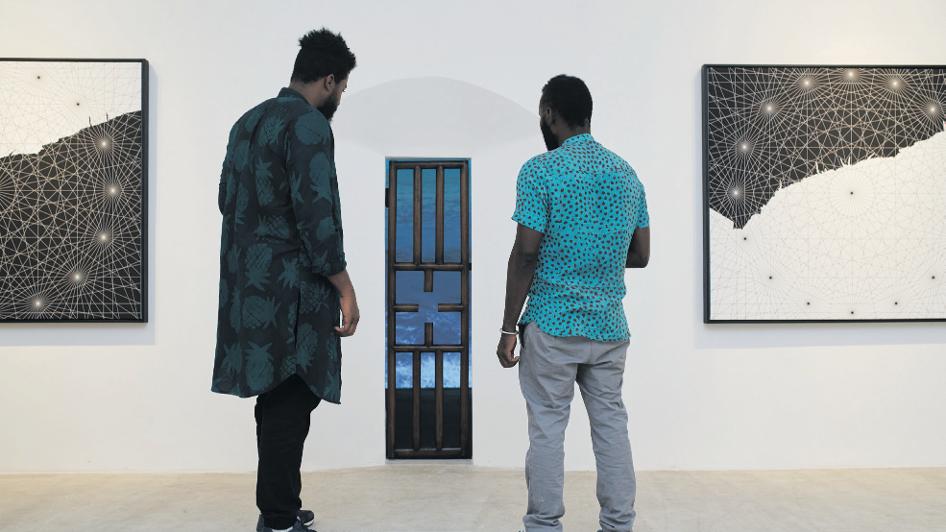
Speaking of technology, what about your panoramic video of the Atlantic at the end of this exhibition? It’s either a beautiful conclusion …
L&B … or a menacing one …
JW … particularly if the door is closed, thereby invoking the “Door of No Return”. You can’t pass through it. It’s like Duchamp’s Étant Donnés in Philadelphia, where all you can do is look through a peep hole onto an erotic scene, being denied something that is highly desirable. L&B That brings us back to the first piece we ever made, two kitchens side by side, one old and one new. The old kitchen had wooden floorboards, a table, a chair, rusty cutlery, peeling wallpaper and from inside you looked through a window onto a mirror image of the same room, identical but brand new. All the objects were in the same positions but pristine and shiny and you were denied the possibility of physically entering it.
The denial of entry into our video installation here, with its view of such a vast expanse of water, only serves to reinforce its sinister undertones.
JW You flank the doorway with two Dutch maps, indicating wind directions amongst other things, again so beautiful …
GC-H That word, “beautiful”, keeps on occurring. This is a difficult area to navigate with respect to that adjective. “Beautiful” arises out of a particular bit of aesthetic history, which like the Enlightenment, is something you can abstract things from, it implies a kind of moral underpinning. One could live in Georgian London with its beautiful buildings, eat amazing fruit like pineapples for the very first time, but the cost of that beauty was
a strange dissonance. It’s so poignant, ugly because of its beauty. It’s heart-breaking, like a piece of music by Benjamin Britten – those notes which make you want to leap with joy, but also cry with pain. It’s a taut emotional stretch arising out of the question as to “how do I live with this?” because it is a beautiful view to the horizon, but it leads ultimately to the death of who you are. It’s human dignity, not just the person losing their freedom and their loved ones, but the humanity which is being lost through that door. Beauty, if anything, is their goal, and that is what being lost.
JW I’m not a big believer in beauty, as it happens, but certainly I see a distinct elegance characterising the work of Langlands & Bell. For example, their plan of the British Museum Reading Room, corresponding to prehistoric architecture, stone circles and so on, seems to be feeding something intuitive in terms of aesthetic desire – sheer visual pleasure – and yet it is a beauty ari-sing out of the most evil, awful ugliness … That tautness is at the heart of this exhibition.
GC-H It’s interesting to use the disciplined language of architecture, which if anything defined the Enlightenment, and our understanding of an idea of a particular kind
of absolute classical beauty – something that we can all relate to, standing almost separate from morality, but at the same time, we know so well – particularly those who are excluded from certain sorts of cultural territory – that it comes at a cost.
JW Ironically, it was around that time that the equation of beauty and truth was formulated …
GC-H With a kind of fascism as the end result, devasta-ting huge amounts of Europe.
We have to be very careful when dealing with the history of African enslavement. It’s not like the story of the holo-caust for which there have been apologies and attempts to come to terms with it – although we never really
can – but at least there have been attempts, but because we’ve haven’t meaningfully tried with slavery, there’s something unresolved which is so raw and bloody, … the architecture in Ghana that you are dealing with certainly reminds us, but then it becomes something very resonant and powerful in a different way.
L&B That’s what’s so important about these buildings, confronting you with the horror – when you’re in the spaces that actually witnessed it, it’s completely undenia-ble. We’re not remaking these buildings, we’re showing a system – on the face of it benign, sometimes quite beautiful in appearance, but the underlying structure is there, still there. What it grew out of and what it gave rise to subsequently can all be seen as evidence – in these motifs, these stories, these plans, these constellations of parts that are brought together …
The Enlightenment was about being rational, and these plans are supremely rational. These buildings were designed largely by military engineers – architects unknown to us – extremely pragmatic with horrific purpose. The language of the visual forms is something that we’re quite familiar with.
Recently we were talking to a young Ghanaian artist about the forts, and he said simply “I know they’re there, but they terrify me and I would never go inside …” He had been to Scotland, where everyone is obsessed with castles of a different kind – evocative of romance and chivalry – and he found it very hard to reconcile the two. He’d never thought about forts and castles in that way …
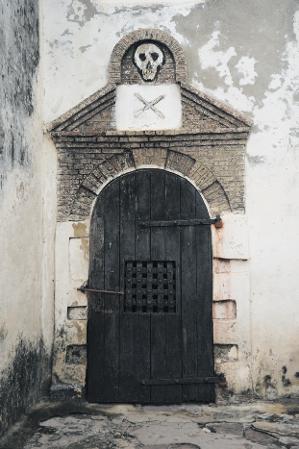
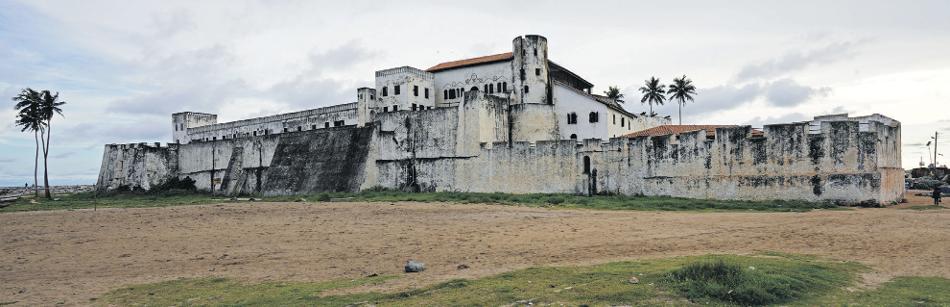
Elmina Castle, Ghana, photos Langlands & Bell.
< The Condemned Cell at Elmina Castle
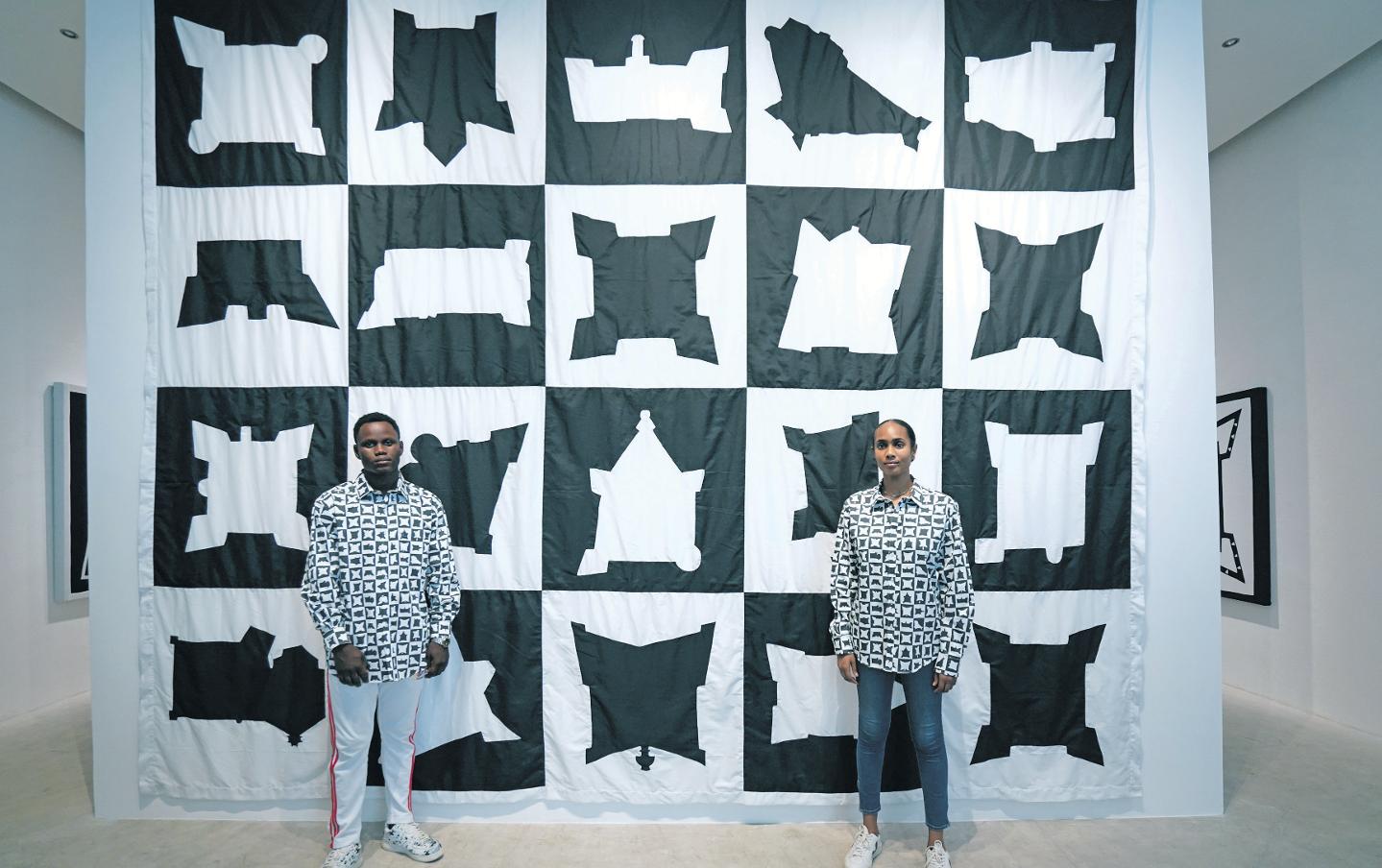
The Past is Never Dead 2021 (cotton appliqué)
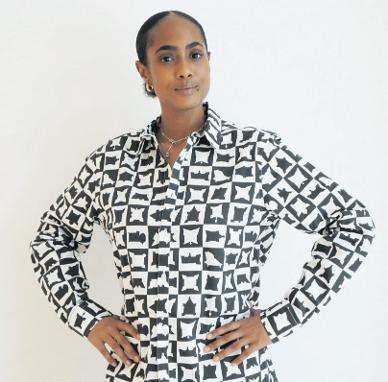
Esi Hayfron Benjamin wearing The Past is Never Dead 2021 (printed cotton shirt), photos Langlands & Bell
JW How these buildings are used now is interesting. For government offices, tourist attractions – or as places of pilgrimage for so many African Americans, making a return journey.
L&B When we were at Elmina and Cape Coast there were many people bringing wreaths to pay their respects GC-H There is that thing for many people of African descent, living in the West – a dislocation from their heritage, a sense of permanent mourning for something lost but you don’t actually know what it is. And then when you go to retrieve it, to recover it, and then often face another layer of rejection because you are seeking out something fictive, or something that doesn’t exist anymore. That’s a very heavy thing to bear.
L&B We felt awkward when we were in a room in
one of the forts, where there were people visiting from America, seeming to resent the fact that we were there with them, in what was a kind of sacred space – watching us closely while dreadful things were being told by tour guides. It was as if we were intruding on something, and we felt very self-conscious, being implicated because of the racist history that we now know.
GC-H The way I mostly experience racism is in tiny incidents on a daily basis, countless micro-indiscretions exhibiting an aggressive, corrosive ambient racism that is impossible to deal with because the perpetrators would say “I didn’t mean to do that, or it’s in your head” … Those sorts of things accumulate over a period, and they fester and become something very toxic, very powerful. It’s why often when black people get together they feel they can relax in a different way … I imagine those people you met in the fort were feeling the grief, the anger and the rage and wanting an opportunity to vent, but couldn’t because other people might see it as awkward.
L&B Objectively they understand that anger is frightening, confronting, and it’s difficult for others
to deal with, but it’s completely natural …
GC-H That anger is double-edged …Manifesting fear can be perceived an aggressive thing too. A black man feels that aggression when he is walking down the road seeing someone clutch their handbag more tightly, ge-sture toward their wallet, or a look of fear on their face. Constantly black people are trying their best to not react and manifest the very behaviour that racists expect – they swallow their rage. And so the environment of the forts is one in which you want to scream, you want to shout, you want to be outraged – and perhaps you can, you can. Your work reduces a black hole of misery, resentment, upset and anguish, and tragedy, to something which is borderline beautiful, presenting us with a complex set of calculations and equations to
deal with. It is taut, powerful, difficult – very difficult
JW Just as you felt that you were making an intrusion on hat tour, so your exhibition could be seen as an intrusion.
L&B It will be interesting to see what the reaction is … We work consciously and unconsciously, intuitively and objectively, with beauty in our work, and we get stick or that – some people think that contemporary art shouldn’t be beautiful, but rather messy and filthy like our old kitchen … When we were in Kabul, to make the work about Osama bin Laden, we were once having a hotel breakfast and overheard an American couple, slightly older than us, having a meeting with an Afghan woman. She had recently taken them to a school she had set up in a ruined building to teach girls how to sew, to support themselves and their families. The sewing machines were powered by half the girls pedalling on static bikes to generate the electricity needed to run them, while the other half sewed. Then after a while the two groups of girls would swap roles.
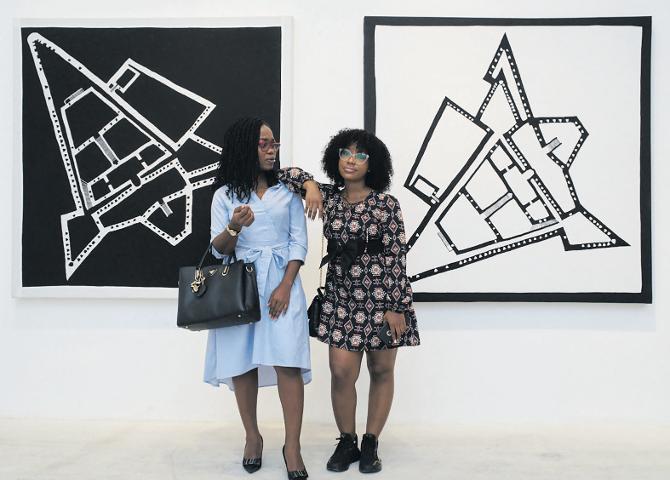
Private view guests at Gallery 1957 with Fort St. Anthony, Axim 2021 (stretched cotton appliqué), photo Nii Odzenma
What she had to say was so interesting and so, after their meeting, we introduced ourselves to the woman, politely, and asked if we could visit the school. She rose to her feet, with eyes flashing, and said loudly, “What are you doing in Afghanistan?” We explained that we were doing research for an art project and she said, “We don’t need more research, we need money”, turned on her heels and walked out. The American couple apologised and we said “Don’t worry, we understand her feelings completely”. GC-H There’s something about Britishness, our history, our culture, and the fact that we do not negotiate our past well. Perhaps we should reflect and do that thing that we never do, and apologise. Emotional restitution is something we need to deal with before we can begin to conceptualise and articulate intellectually, in order to dissipate that rage. We need to find new ways of begin-ning conversations about the history of colonialism and African enslavement – and art can help us do that.
The Past is Never Dead …
Gallery 1957, Accra, Ghana,
20 May – 12 July 2021