
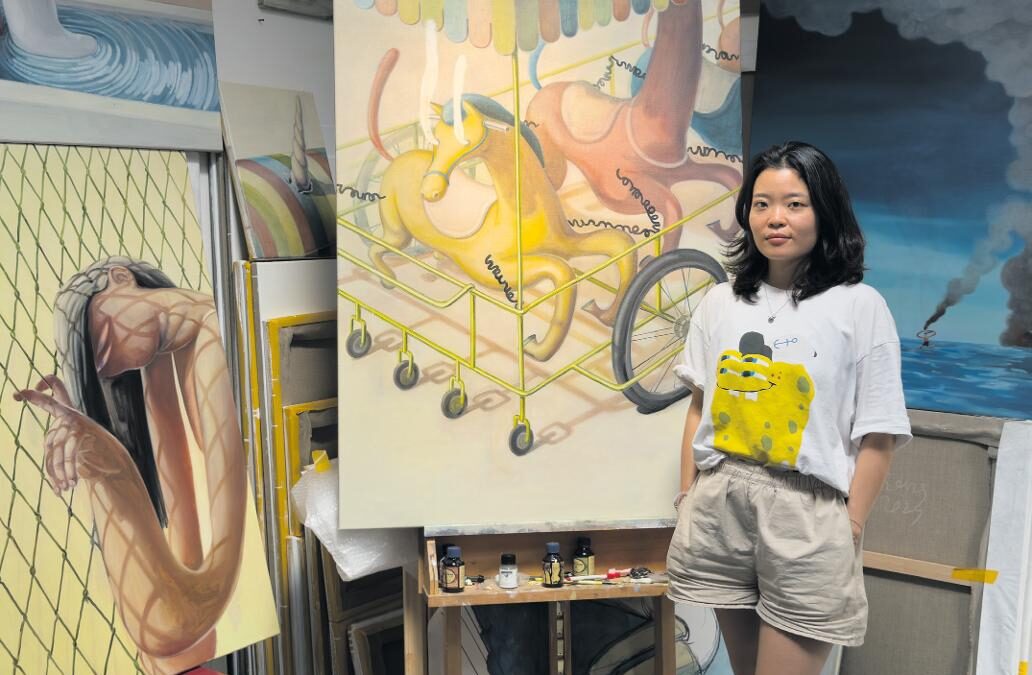
Portrait by Uscha Pohl
Elastically stretched rubber figures, swelling forms in washed-out pastels, dripping feet, and ever-recurring flip-flops – one lying down, one flowing, one long, one short – runaway carousel horses, socks, hidden characters behind curtains, beneath T-shirts or inside generously crumpled cloaks; a hunched figure touches a fence whose shadow stretches over them like a net; cardboard trees, standing or lying down with their supports in the air; forests of houseplant pots; smoking eyes, smoking houses or people. A lake laps around the feet of a solitary figure sitting on a chair – this time, the flip-flop drifts by like a swimmer, the fishing rod lost… Jeehye Song’s paintings present an imaginary world born from a mixture of feelings, thoughts and lived experiences.
Surreal in appearance, influenced by Surrealism and sketched in a comic-like style, these allegorical oil paintings are rooted in things experienced, felt and found, which become entangled in the subconscious and re-emerge in dreamlike form. Jeehye Song paints a dimension of her own into which we allow ourselves to be transported — an “intermediate space” beyond familiar realities.
Jeehye Song’s “fifth dimension” is an artificially created and abstracted reality, yet one that feels remarkably close and tangible. The muted pastel palette evokes twilight: the moment of transformation, from day to night, from one world to another; a state of being present while simultaneously being absent — or perhaps not wishing to be present at all.
The protagonist is the self within the painting – the viewer, who feels transported into the scene. Perspective is often suspended or dissolved within the image, while Constructivist elements intertwine with a kind of faux realism, and shadows move in opposing directions. Song draws abundantly from her own visual language, delighting in a wealth of visual oxymorons.
The urgent subject matter of her work is visually softened by her light-handed brushwork, pleasing colours, and figures that are either angular or rounded (stretched like chewing gum, padded like sofas, or distorted in ways that defy their intended function). The child-friendly comic aesthetic and a healthy dose of self-deprecating humour further temper the intensity of the work.
Born in Seoul, South Korea, in 1991, Jeehye Song developed a pronounced desire for freedom at a very young age. Her surroundings – and the country as a whole – placed great importance on conformity, adaptation and economic success. Dismissed by her younger sister, who is two years her junior, and by her peers as a “dreamer,” Song found refuge in drawing. Even as a child, she dreamed of being able to live and work creatively as an adult. An example within her own family showed her that this dream did not have to remain just a dream: her mother’s brother had studied art and worked in communication design.
Traditional schooling became unbearable, and for her final years, Song transferred to a high school specialising in Comic Art. However, given the considerable social pressure to start earning money quickly, pursuing a degree in fine arts was not a realistic option after graduation. Instead, Song first studied printmaking, followed by metal art and jewellery design. She worked for a year as a jewellery designer in Seoul, but the job did not meet her expectations. “We took jewellery trends from the internet and turned them into 3D-printed models – it was very depressing.”
The importance of what is now widely known as mental health was not only largely unrecognised at the time, but also surrounded by considerable stigma. “I didn’t want to seek help in Korea because the subject was taboo for me and the people around me. It was better to say nothing, just to be safe,” Song explains.
The desire to “get away from everything” continued to grow, and encouraged by Korean friends living in Germany, Song began to consider studying visual communication design there. In August 2014, at the age of 23, Jeehye Song arrived in Frankfurt am Main, where she attended German language courses and began preparing for her studies.
During a portfolio consultation, however, a professor from the Academy of Fine Arts in Nuremberg recommended that Song pursue fine art rather than applied art, pointing out that she had already acquired the necessary technical skills in Korea. Her portfolio was therefore submitted to the Kunstakademie Düsseldorf.Song had already booked a flight back to Seoul on the very day she submitted her portfolio in Düsseldorf and was preparing to return home. Her joy was all the greater when she was accepted. Over the following years, she studied under Stefan Kürten before transferring to Professor Andreas Schulze’s class in 2018. “Being far away makes things more relaxed; the pressure is less intense,” says Jeehye Song, who now considers Düsseldorf home and, after ten years there, has no plans to return to Korea or move elsewhere. However, “less pressure” does not mean that the pressure has disappeared altogether. Her guiding motto remains: “You can sleep when you’re dead.”
“My work was considered too dark by many people for a long time.” The smoking eyes? “They represent the release of inner pressure,” Song explains. In other words, the soul is smouldering; wisps of smoke escape from blind eyes, rising from an inner fire. The fence in the painting carries a double meaning, symbolising both protection and exclusion.
“When you take everything in without having a release valve, you become ill. For a long time, I didn’t realise that depression had become my normal state. In 2019, it all became too much: everything was exhausting, and I couldn’t go on. So I went to the emergency department at the LVR Clinic in Gerresheim and explained that I no longer wanted to live. I was admitted immediately for an indefinite period, but before long, my compulsion to work and my worries about my bank balance began to outweigh everything else. At my insistence, I was discharged after two weeks, with antidepressants in my pocket. Two weeks were too short for any fundamental improvement, but the pills worked wonders: the world was suddenly colourful, and an inner calm spread through me. It was an entirely new feeling!”An unexpected side effect soon took her by surprise, however. “I could no longer paint! In my work, I put my inner self onto the canvas; painting is, in a sense, my therapy – and now nothing was coming from within. Only silence,
no images!”
And so began her dance with the medication, on and off. “By now, I know both the medication and myself very well. These days, I take a very low dose, just enough to keep me from crashing, but not so much that I lose myself. I hope I’ll be able to stop taking it altogether one day – splitting those tiny tablets is quite a tricky business!” — Uscha Pohl
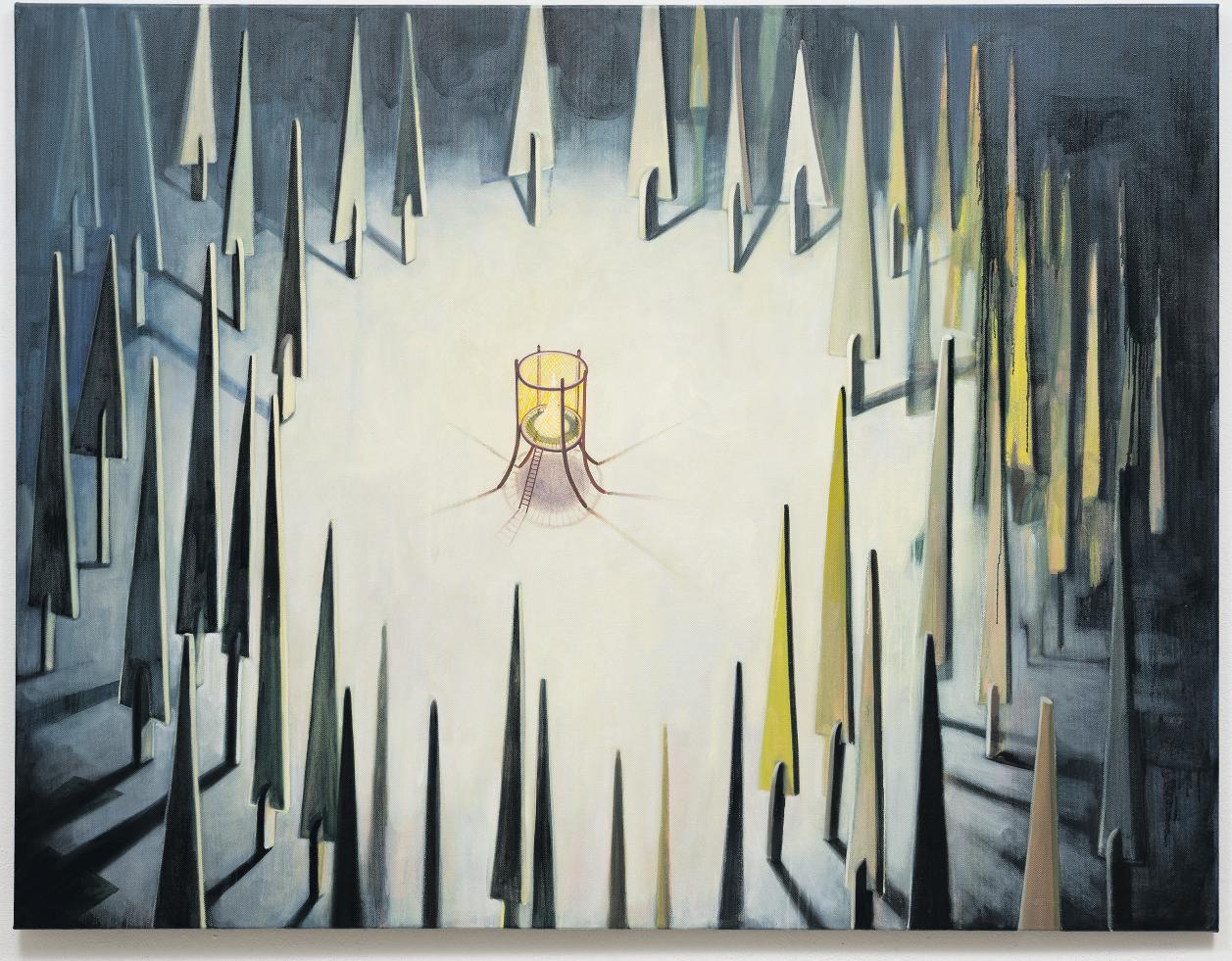
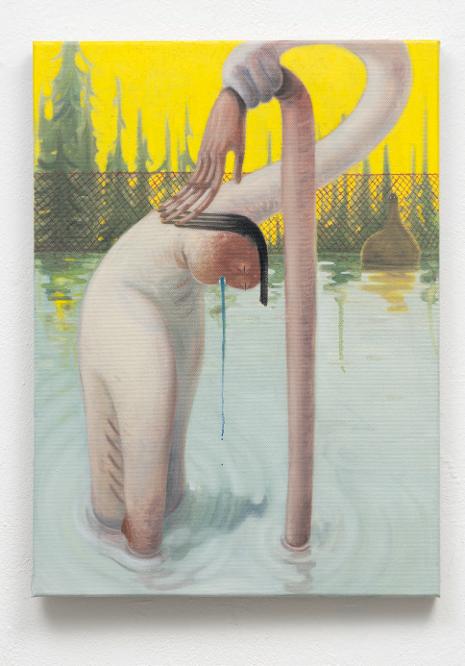
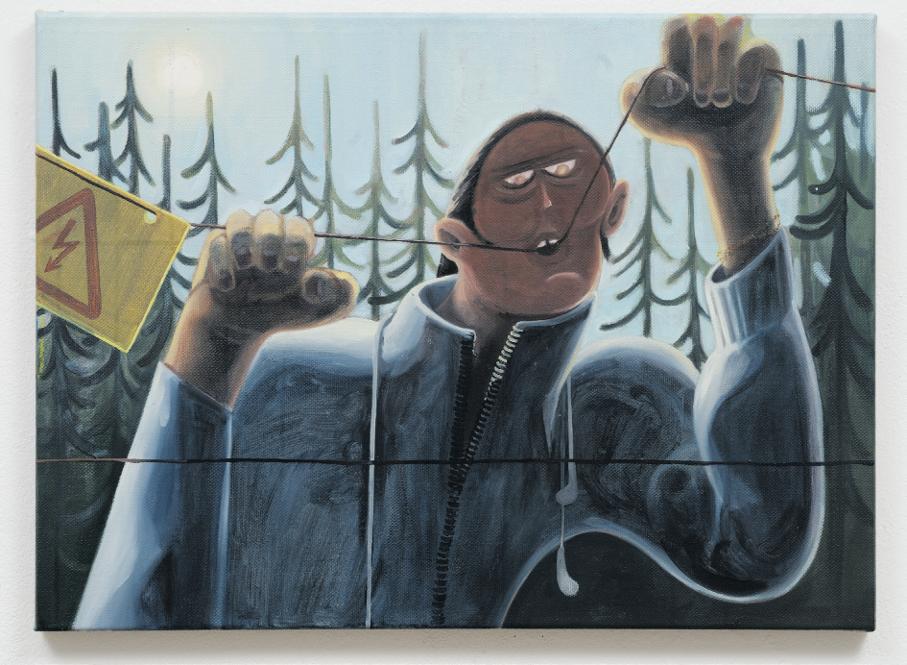
clockwise: dream house, 2026, oil on linen, 130 x 170 cm Let me in, 2026, oil on linen, 55 x 75 cm; Selbsttrösten/ Self Comfort 2026, oil on linen, 75 x 55 cm, images © Jeehye Song / VG Bild-Kunst, Bonn 2026
There are moments when you are at home and yet still want to go home. Rather than resolving this quiet ambivalence or assigning it clearly to one side, the work begins by capturing, through drawing, the suspended state in between.
Many of the works depict bodies whose positions leave it unclear whether they are resting or simply no longer able to go on. They hang, lean, or sink into postures that seem both ordinary and improbable, barely distinguishable between wakefulness and withdrawal, physical presence and inner detachment. More important than a dramatic event is the moment when the emotional balance within an apparently uneventful scene shifts ever so slightly, particularly where a familiar scene is subtly distorted, giving rise to a quiet sense of estrangement. Restlessness seeps into stillness without either feeling displacing the other.
The light, too, carries this unease. Luminous colours and harsh, artificial-looking light contradict the heaviness of the bodies and lend the scenes a quiet sense of humour. Hard shadows give the spaces an unstable, almost staged quality, while dream and reality remain indistinguishable.
In more recent works, space increasingly opens out into the landscape. Plants, bodies of water, and incidental events in the background are gaining significance, while the figure grows smaller and loses its weight. What interests me is how a figure can recede and yet remain as a trace within its surroundings—not as the centre, but as a fragile presence within a larger context. The aim is not to find an answer, but rather to keep the question open and in motion.— Jeehye Song
aArt Cologne as part of the New Positions Funding Programme by the German Gallery Association (BVDG).
HALL 11.2 B110