
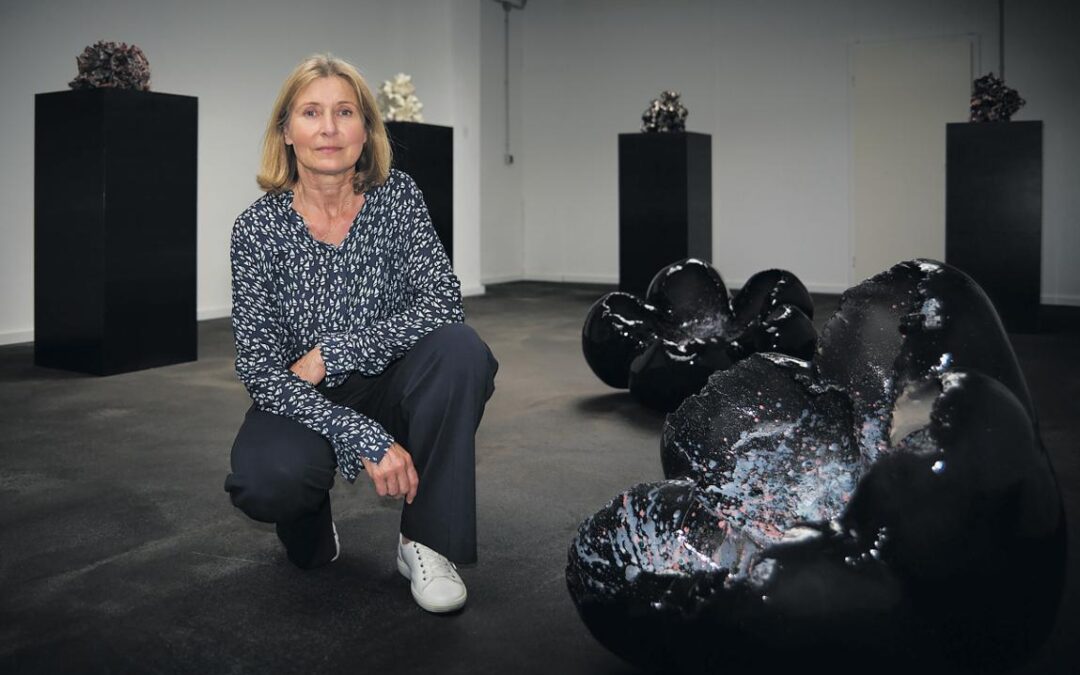
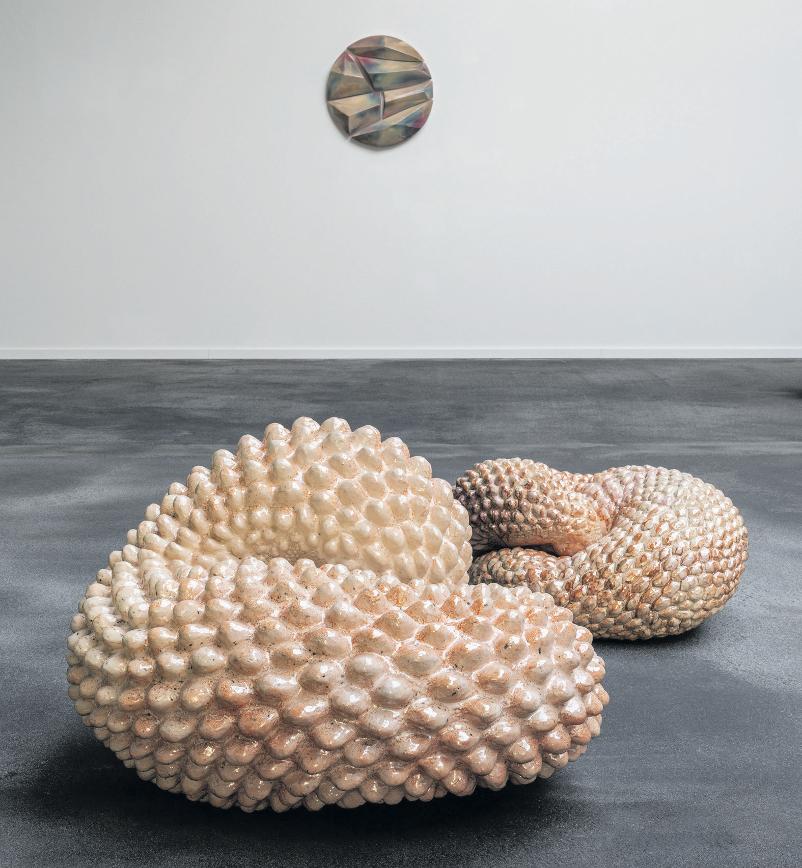
Iridescent worm-like prehistoric seafloor dwellers writhe on the floor while glazed, coral-like porcelain flowers cast elongated shadows—razor-sharp yet delicate to the point of translucency. Giant fireclay flower heads glisten in a dark hue of blue—transporting us into the deep sea or outer space; geometrically textured wall objects shimmer seductively, curved glass arches delineate circular floor areas bathed in hazy red.
The red glass circles, positioned precisely with long nails at specific depths into the floor, glow and cast a reddish light, have an air of coloured church windowpanes, and when one steps into the circle delineated by the
grammatical parentheses, the spatial perspective shifts. The red glow, if it signifies strength, or danger—it does put us ‘on the spot’.
A tension mounts, the works communicate and the sharp flowers survey the room. “They recall flowers laid at accident sites—,” states Anna Zimmermann.
Ink drawings offset the sculptural works depicting real dead insects or birds rather than live imaginary creatures of giant snails and coral flowers. Thus, they bring us from the abstract and alluring ceramic flora and fauna back to the air we breathe and the world we know, but paradoxically, they are all dead.
The dead birds are drawn on glass: installed at a slight distance from the wall, the sun’s path creates a shifting shadow, creating a daily visual migration. The birds depicted had lost their lives crashing into a window, an invisible frontier placed by man; as victims of these | tragic accidents Anna Zimmermann honours them through drawings, on the very material that killed them.
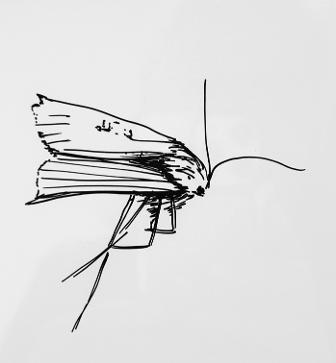
The insect drawings depict dead moths, dragonflies and hoverflies. Despite their constituting a crucial part of our ecosystem, humans often overlook invertebrates and their importance – hardly anyone notices when they burn to death on street lamps. Even worse, we exterminate them en masse on an industrial scale using insecticides and pesticides. Whether intentionally or thoughtlessly, ‘civilised’ humankind is destroying nature – the very basis of its own existence.
Anna Zimmermann’s space comes alive, suspended between beauty and danger, life and death. The gap between the two is life itself, which gains meaning through its terminality.
“The series of large-scale flower heads stems from a memory of a trip to flower fields in Holland. There, the flowers are cut on a large industrial scale – just when they are in full bloom – to strengthen the end product, the bulbs.” explains Anna Zimmermann. Mountains of beautiful, recently murdered tulip heads piling up in a towering mass grave, is an image that has stayed with her ever since, the artist adds. Thus, the oversized floral sculptures resemble a memorial, celebrating the discarded flowers in all their splendour – not in their original colours, but in the dark tones of the universe, speckled with galaxies, or in a sober, passe-partout white. In this way, they represent flowers per se, drawing attention to the transience, beauty and uniqueness of nature, and to its systematic destruction, emblematic of our society today.
The ‘echoes’ of the exhibition are equally physical, as resonance of light, material and space and conceptual. Suggestive forms represent the origin of life and its
cyclical passing. There is a parallel here with the sharp flower blossoms: delicate in their iridescent colours, they harbour danger in their razor-sharp edges and despite their very durable material, they are extremely fragile if dropped.
Furthermore, we humans are the distant echo of the early primordial beings. Whilst all of nature follows its natural cycles, it is us, imagining ourselves separate from nature, who are destroying the rhythm and balance of nature—and with it, the foundation of life. Echoes reminds us that there is always a return, every cause has an effect.
Based in Deggendorf, Bavaria, Anna Zimmermann studied ceramics at the Technical College for Ceramic Design in Höhr-Grenzhausen. A study visit took her to West Surrey College of Art and Design in Farnham, England, and she received a ‘work scholarship for young artists’ at the ‘Europees Keramisch Werkcentrum (EKWC)’, in the Netherlands. Based in Düsseldorf from 1996 to 2008, Anna Zimmermann was a freelance collaborator at the ‘Werkstatt für Bildhauerei’ (Sculpture Workshop), run by Niels Dietrich in Cologne, and was responsible for large-scale commissions including works by Richard Deacon, Thomas Schütte, Rosemarie Trockel, Heinz Mack and Otto Piene. In 2010 and 2018, Anna Zimmermann held solo exhibitions at the Felix Ringel Gallery in Düsseldorf; in 2024, the group exhibition Made in Cologne, organised by Peter Freeman INC., brought Zimmermann’s work to New York.— Uscha Pohl
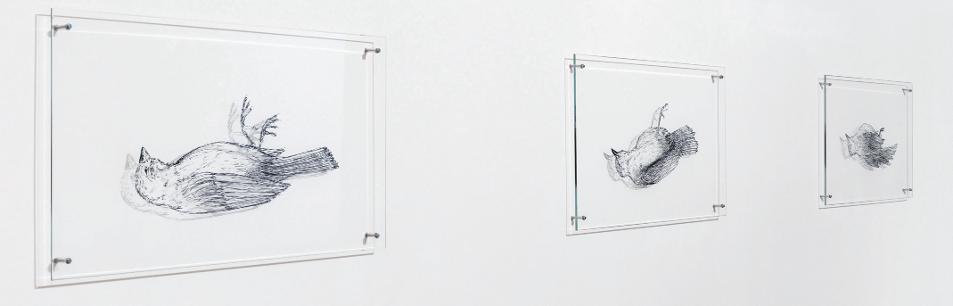
Clockwise: installation view with Mirrorfield 07, fireclay, glazed, 2023, Untitled (RdM 02), fireclay, glazed, 2012, Untitled (RdM 08), fireclay, glazed 2023, photo: Hanne Brandt; Insect (NF 01), marker on paper, 2010; F 1.54, porcelain, glazed, 2025 and Bird 03-05, marker on glass, 2026, photos Uscha Pohl.
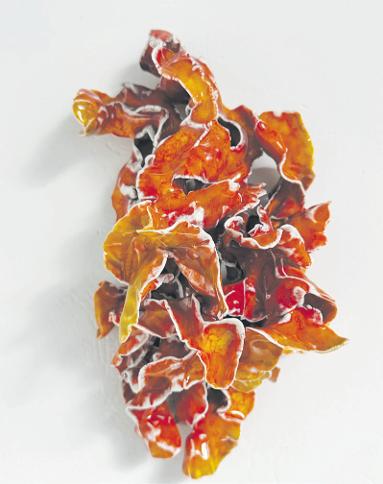
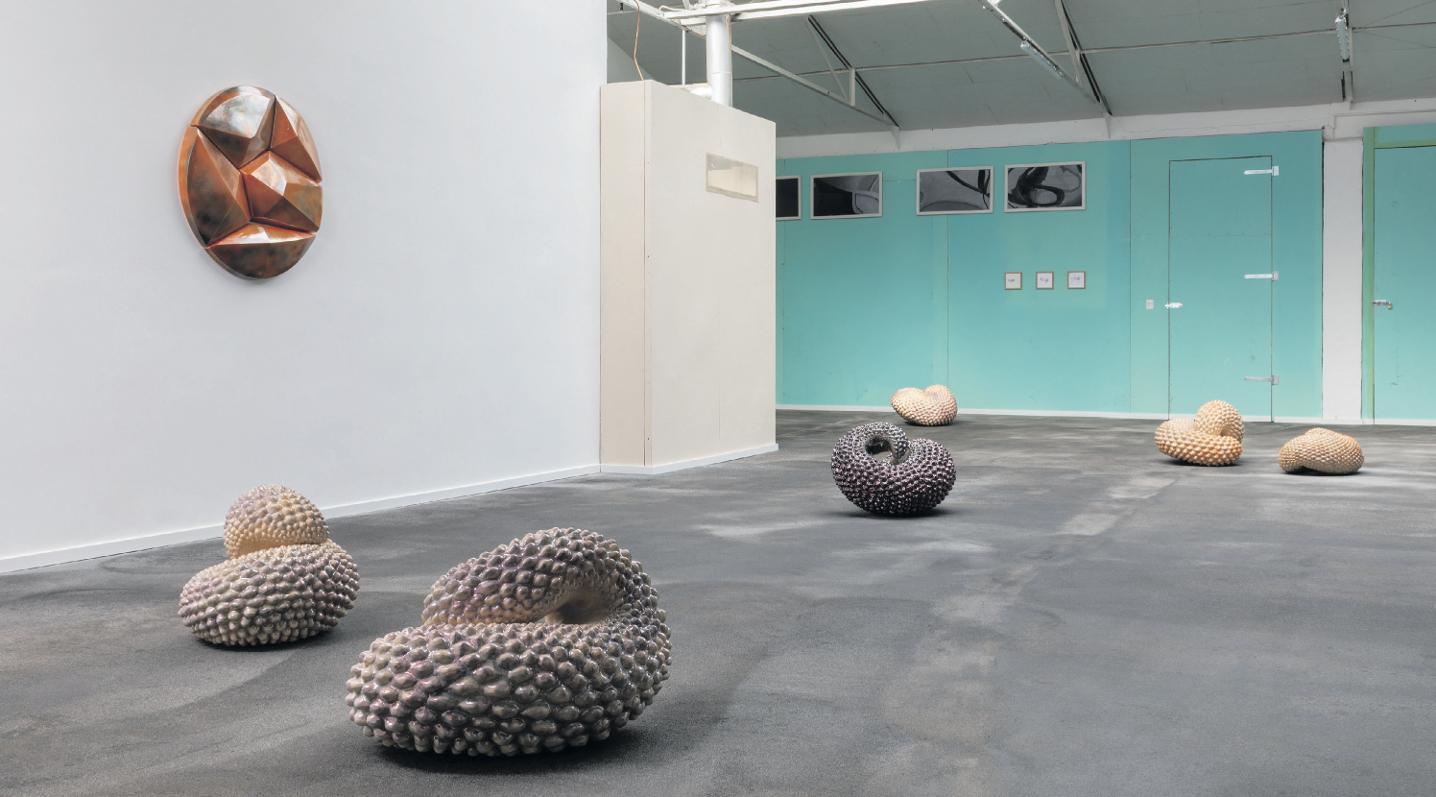
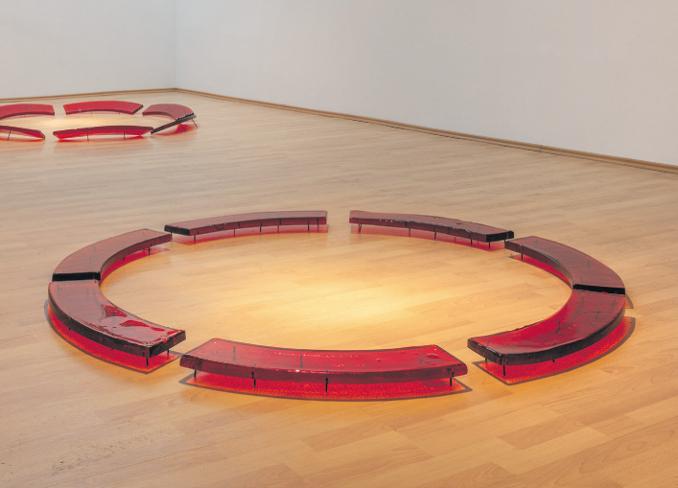
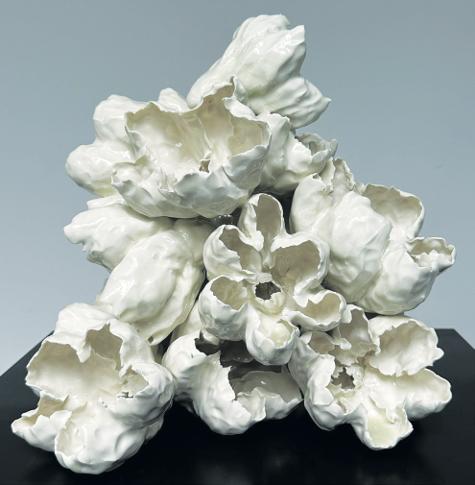
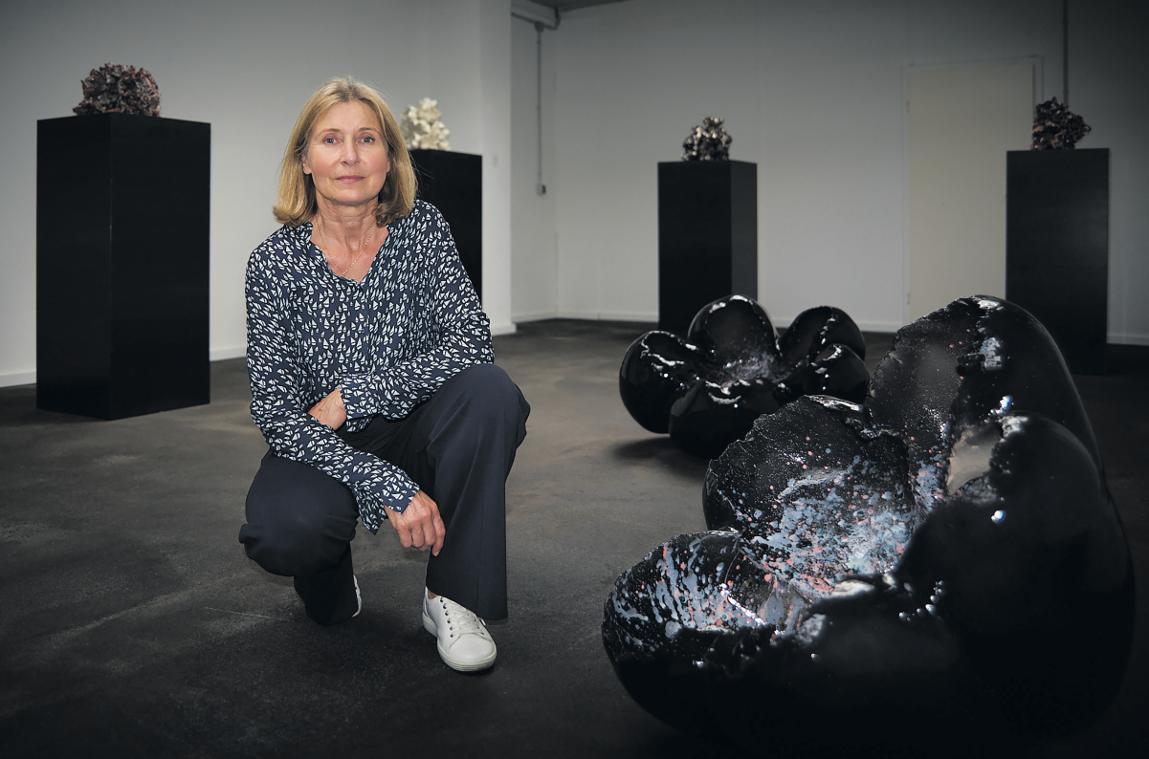
Top: exhibition view with Mirrorfield 06, fireclay, glazed, 2023; and Untitled (RdM), photo Hanne Brandt, center left: Safe Room 02, Safe Room 03, glass, nails, 2025, photo Hanne Brandt; right: F 50, 2013, porcelain, glazed, 32 x 35 x 34 cm, photo Uscha Pohl, portrait of Anna Zimmermann with FG 06 – FG 08, 2023, fireclay, glazed, ca. 80 x 80 x 55 cm, photo Mark Záhorszky
Anna Zimmermann
ECHOES, GARAGE, Düsseldorf
Thomas-schuette-stiftung.de
Upcoming exhibition
Kunstverein Passau
St. Anna Chapel, Passau
May 6 > 11 June. 2027