
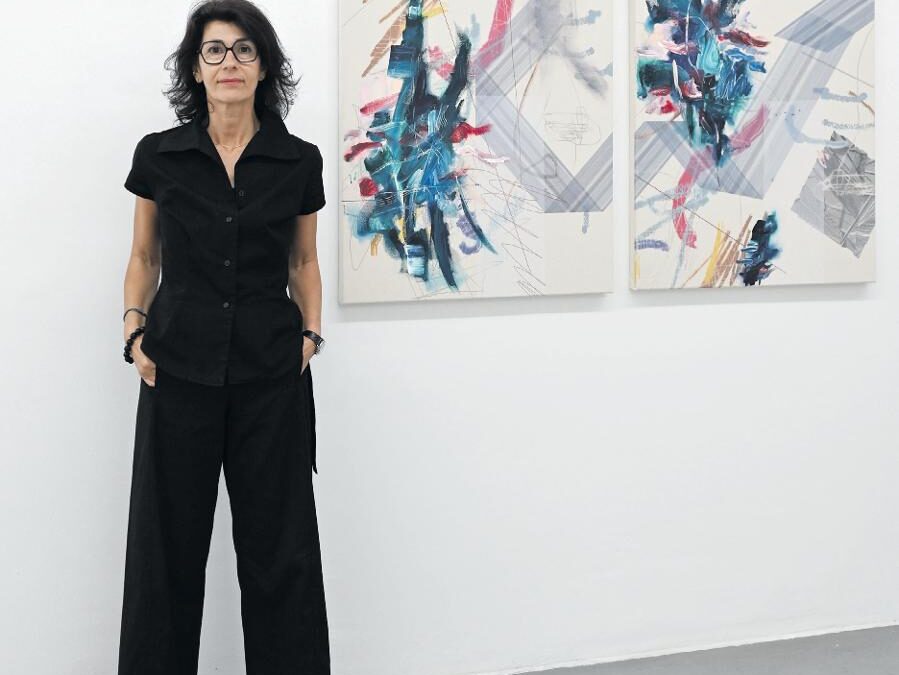
“Here, the calculated, openended drawing of pixels which are virtual, consisting solely of light or computing power, which I bring into the world through printing. There, the tangible paint, offering specific physical properties to which one must respond. Uniting these elements in a composition involves on the one hand a great deal of reflection and planning and, on the other, a very immediate, ‘courageous’ action, to once again trigger the ‘catastrophe’ that brings forth (abstract) painting.”
Thus Isabella Til describes her work which involves bringing into harmony digitally created abstractions with the immediacy of bold painting on canvas. The spontaneous brush stroke completing the dialogue, the dynamic stems from the interaction between the opposing techniques.
It is the contrast of the techniques and the element of fate or fortune in each of them which Til tackles. The human-machine-relationship is in current times uncritically merged. Til explores it visibly on canvas, combining the two, yet pointing out their differences we don’t necessarily acknowledge anymore whilst computers, smart phones and AI assistance are taking more and more part in our existence.
Healthy contrasts and questioning are fundamental to Isabella Til’s oeuvre. Born in Cologne, Til grew up in Essen, nestled in Germany’s historical industrial district. Starting her passion for painting and drawing as a child, from teenage on, Til put emphasis on a balanced life. Attending an all girls catholic school, ”I used to not only visit museums but go dancing and travel if necessary all by myself.“
Studying at the Folkwang University of Arts, Essen, in 1986, Til’s logo design on the theme of gender equality was selected by the local government as part of a design competition. She graduated with honours in 1991 having experimented with photography, graphic design, painting, typography as well as art history. Her works created with the Commodore Amiga exposed on photo canvas and then painted over were awarded the BMW Art Prize of 1988. “At Folkwang, I was particularly interested in the process of photograms looking at the pioneering work of Otto Steinert and László Moholy-Nagy, where light creates images in a very direct manner. Later, I would recreate similar effects through an array of media.” In parallel, the socio-critical colour photography produced by Nan Goldin, William Eggleston et al where equally interesting and Til’s stance on social and ecological developments is essential to her work. “My final graduation project 1991 was creating a fictional but very possible sustainable alternative to the then emerging fast food chains in Germany. I managed to present environmentally conscious solutions to every angle of the business from food sourcing to the stores and packaging.”
Lured by interesting contracts, Til first launched herself into graphic design as art director in Düsseldorf, catering to the international market. 1999 growing further in this field would have meant moving to The States, where she had already garnered widespread attention through multiple awards from the Type Directors Club – and Art Directors Club New York since. Til decided to open her own design studio in Düsseldorf instead, and in 2016 returned to art — her original passion – with a new life-experienced perspective.
Inspired by her early constructivist photograms, Til looks at form and light juxtaposing traditionally handcrafted and digitally created processes, the real and the artificial, the actual and the virtual. Techniques as varied as photography and screenprinting to painting and drawing, computer sampling and conceptual sculpture sit side by side. Rejec-ting stereotypes, in Til’s work nature and technology form one image, abstraction alternates with the symbolic, the pre-arranged with the spontaneous, the calculated with the intuitive, the disembodied with the corporal—drawing on socio-political and feminist subjects.
Recent works display a return to drawing, with the subject ‘hands’ taking center stage. “Our hands are important, to build, to draw. With progressive computerization, we use our hands differently from all previous generations, with yet versatile and stubborn handcraft slowly going extinct in daily life. We come to know only the one-dimensional smoo-thness of scrolling, zooming, button pushing. My painting here shows the hand of a teenager holding a phone – without the phone.”
The hand floats in an abstract space holding the void of an imaginary phone, while flat b/w printed and cut-out emojis suggest actions and emotional states of the holder. One emoji shows a writing hand with pen and paper – an action the very technology is pushing to extinction.
A new sculpture features a lifesize bronze-cast lifebuoy made asking ‘What Time Is It?’. Is it high time, or soon too late? In a time where destructive division is actually fostered by society and fuelled by (digital) ‘progress’, Til’s masterful balancing act not only integrates but brings to the fore a multiplicity of opposites – as one. —Uscha Pohl
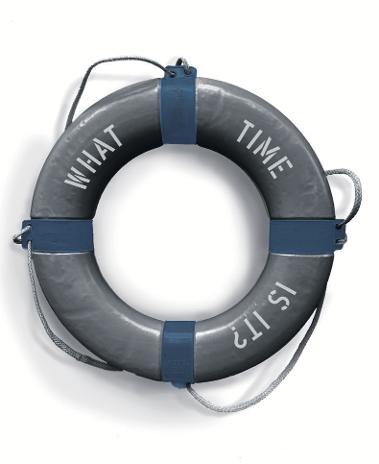
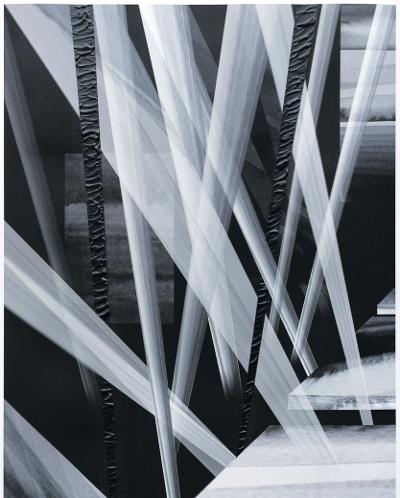
Clockwise: photo F. Ringel, in the back diptych One Hand Other Hand, 2024, acrylic, oil, print on raw canvas, 100x150cm; What Time Is It?, 2026, model animation for wall object, ca. 56cm; Area 6.5, 2017, pigmentprint, acrylic on paper, 57x47cm