
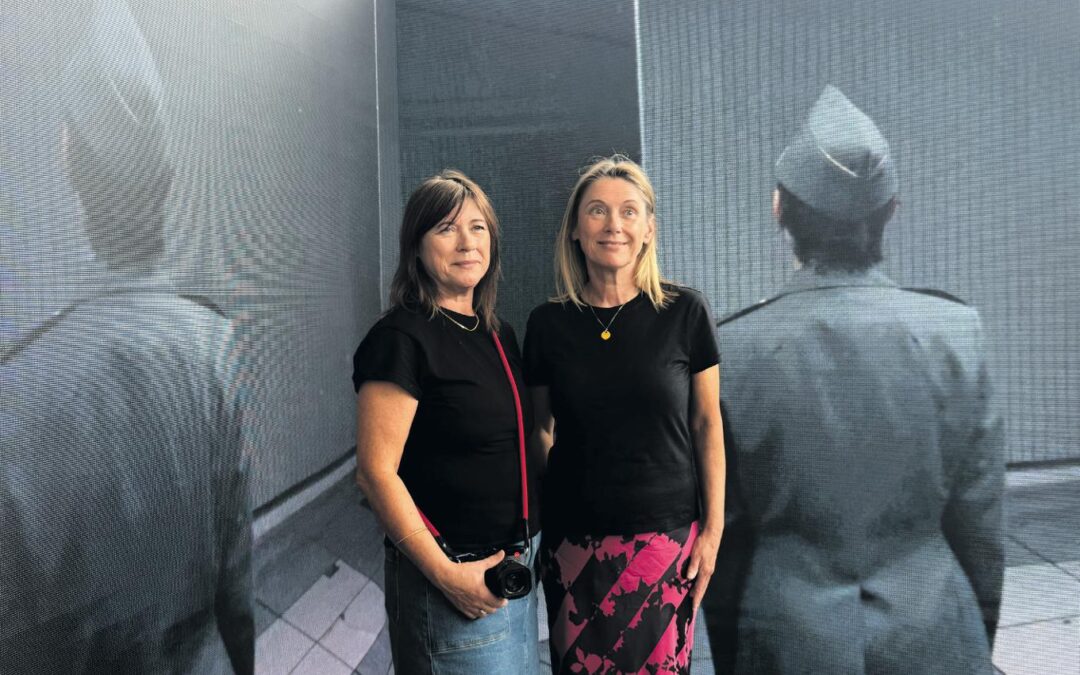
Featuring works spanning three decades, the central theme of decoding of ‘power’ and various facettes of its exertion in societal, political context, ultimately, beautifully, gave way to poetic artistic exploration of the universal notion that we are all ‘one.’
Since photographing Stasi City, 1997 at the former headquarters of the GDR Ministry of Security, the (identical) Wilson twins have worked with numerous reclusive locations. They entered as first – or one of the few civilians ever granted access the Baikonour Cosmodrome in Southern Kazakhstan, the historical centre of the Russian Space programme in 1999, for example.
With Konvas Avtomat, the Toxic camera, 2012 – a bronze replica of filmmaker Shevchenko’s camera on a luminescent plexi plinth, Jane and Louise Wilson pay homage to the Ukrainian director and his team who gave their lives for capturing the immediate aftermath of the Chernobyl nuclear disaster, for the documentary
Chernobyl: Chronicle of Difficult Weeks. Atomgrad, nature abhors a vacuum VII, 2010, an image taken by the twins on their own visit to the exclusion zone twenty-four years later, illustrates the scene Shevchenko had witnessed first-hand.
The title Gamma (1999/2023, video) refers to the electromagnetic radiation emitted in the process of radioactive decay. Filmed in 1998 at the then-recently decommissioned USA Air Force base Greenham Common in Berkshire, a former Cold War Base for NATO nuclear strategy, Jane and Louise Wilson were among the first civilians to gain access. Staging what previously had been daily activities at the base, Jane and Louise enacted routines and controls in uniform or protective gear in the eerie setting. The double-image, four-screen video installation, with the images merging into one another, mirroring and multiplying reality, brings ever-new dimensions into play.
“We have a personal link to this location,” explain Jane and Louise Wilson. “In our youth we witnessed the
protests against this base, with police going after the protesters. A ‘Women’s Peace Camp’ had been set up here from 1984-1989.” A rattling sound from the distance makes the visitor wonder and turn around to locate its source – “That is the noise of metal spoons rapping along the metal of the fence around the base – it was the alarm protesters would sound when police had arrived. Pre-mobile phones, this was the ‘bell’ to alert the others.”
More recent works ponder anatomy, biology and spirituality analysing micro- and macrostructures, in drawings and installations rendering visible our universal oneness. The film Performance of Entrapment, 2025 connects the Ise-Jingu Shrine (Japan), the Ise Ondo, women who have transmitted body-bound knowledge through spiritual practices over centuries – and the Haenyeo, (older) women free divers of the Korean Gapado island, renowned for harvesting urchins together. Thus training their lens on our origins and traditions in harmony with nature, Jane and Louise Wilson conclude here with light, unity, strength, wisdom and (inherent, natural) power.
Yes to all. — Uscha Pohl
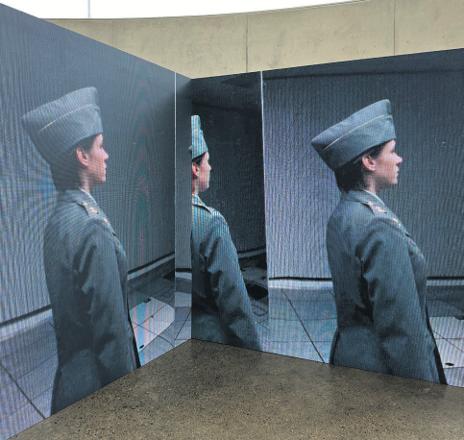
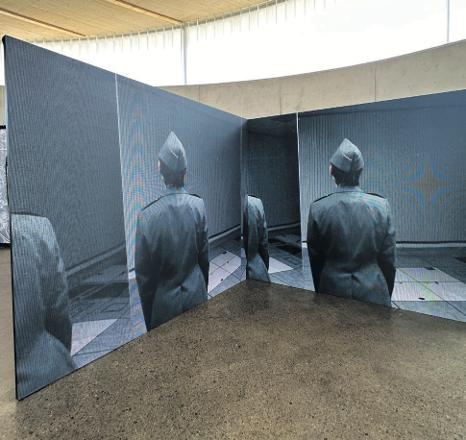
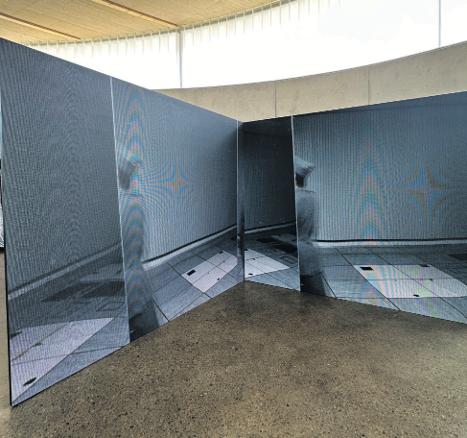
ane and Louise Wilson, GAMMA 1999-23 (Digital Video 4-channel video installation, colour,stereo sound; 16mm film transfer) photos Uscha Pohl
Chernobyl: Chronicle of Difficult Weeks
Filmmaker Vladimir Shevchenko, born in 1929 in Balta, Ukraine, was the award-winning TV film director handpicked and hired by the government to document Chornobyl’s exclusion zone three days after the explosion of the nuclear reactor in 1986.
The dangers being downplayed by the authorities, Shevchenko and his two assistants – like all the people engaged in the clean up, were candidly unaware of the extent of the danger they were exposing themselves to. On film Shevchenko captured lines of uniformed men without as much as a paper face mask, while in the documentary workers (called ‘biobots’) are seen taking their gas masks off to’ breathe more freely’ while working. The most deadly contaminated area was the roof next to reactor four, where biobots were rushing in 90-second shifts to limit exposure. In the film however we can see Shevchenko calmly filming from the top of the building, in coat, cap and mittens, entirely unprotected.
When developing the film, Shevchenko first mistook the spots in the images for damaged film material, only to realize later that these were a direct impact from radioactive material entering the camera, capturing on film the radioactive material. Later it transpired the metal camera itself had absorbed so much radioactiivty that it had become a lethal tool.
Upon realisation of the deadliness of Shevchenko’s camera, it was buried deep below ground to avoid further contamination. Chernobyl: Chronicle of Difficult Weeks, about the clean-up of the radioactive material at Chernobyl, would be Shevchenko’s last film. He passed away within a year after filming, followed by the assistant who had handled the exposed film camera.
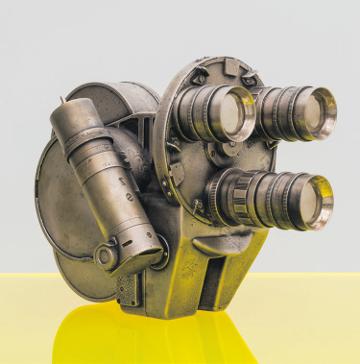
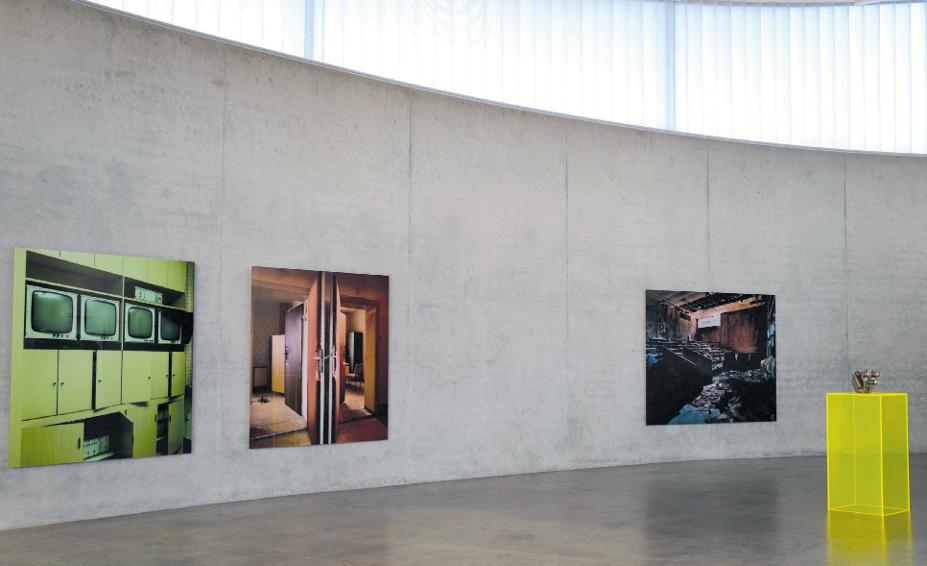
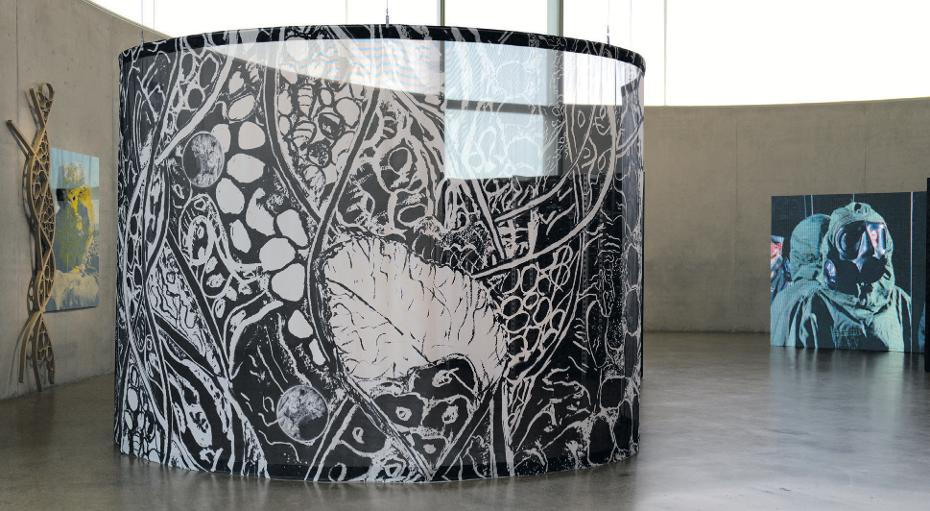
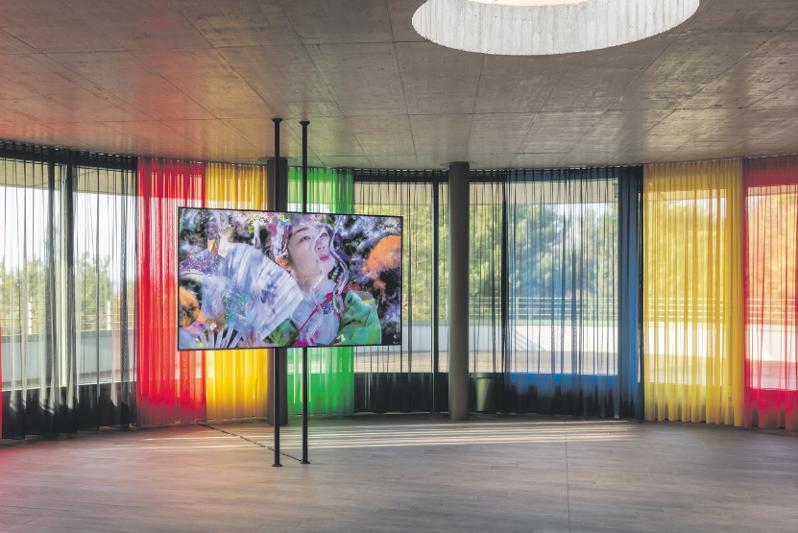
From top: Installation photograph by Jane and Louise Wilson, 2026. L-R Monitor room, Stasi City 1997 (C-type hand print mounted on aluminium with Diasec 180cms x 180cms); Double doors, Hohenschönhausen, Stasi City 1997 (C-type hand print mounted on aluminium with Diasec 180cms x 180cms) Atomgrad, nature abhors a vacuum VII 2011 (C-type hand print mounted on aluminium with Diasec 180 × 225 cm); Konvas Avtomat, The Toxic Camera 2012 (Bronze, 24.8 × 19.7 × 19.7 cm with perspex plinth); nstallation view photograph by Jane and Louise Wilson 2026 L-R Transmission II, 2022 / 2025, (Handprint on aluminum with Diasec and
UV emulsion, steambent oak wood); Dendrophlies 2026 (printed sharkstooth gauze, steel hanging frame, weights, W: 7.650m
H: 2.950m) GAMMA 1999-23 (Digital Video 4-channel video installation, colour, stereo sound; 16mm film transfer) Installation photograph by Jane and Louise Wilson, 2026; Installation view: Performance of Entrapment II, 2025 (Video, color, stereo sound; 16mm film and HD transfer) Photograph by Hanne Brandt 2026.
< Konvas Avtomat, The Toxic Camera, 2012 (Bronze, 24.8 × 19.7 × 19.7 cm with perspex plinth), photograph courtesy of Maureen Paley by Mark Blower, 2022
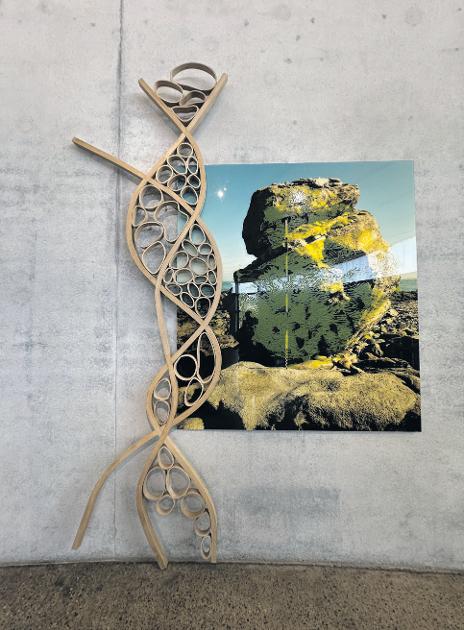
< Transmission II, 2022 / 2025, handprint on aluminum with Diasec and UV emulsion, steambent oak wood)
Countermeasures, Jane & Louise Wilson,
curated by Juliane Duft, Thomas Schütte Stiftung, Neuss August 2026. The paperback accompanying the exhibition is available at Skulpturenhalle Neuss. Current exhibition at the ‚Raketenstation‘ is celebrating the 10 Year anniversary of the Skulpturenhalle 2016-2026:
Thomas Schütte — Women
(through 11 April.2027)